Summarise this page 8 key points · 1 minute
- What is Kato Paphos like?Kato Paphos is the harbour district, combining the UNESCO-listed Paphos Archaeological Park with a seafront promenade, castle and a large year-round expat community.
- Where is Kato Paphos and how do you get around?Paphos airport is 15 minutes away by car, a daytime bus single costs €2 and a 30-day pass €50, though most residents still keep a car.
- Neighbourhoods and places in Paphos townKato Paphos by the sea and Ktima, the cheaper old upper town, are linked by Apostolou Pavlou Avenue, with seafront, harbour and residential pockets in between.
- Who is Kato Paphos best for?It suits retirees wanting flat walkable streets, families near beaches and schools, remote workers seeking lower costs than Limassol, and culture lovers.
- Homes and cost of livingAs of October 2026, one-bedroom flats rent for €700-€950 a month and two-bedroom flats €850-€1,300, with Paphos apartment prices up about 18.5% a year.
- Schools, healthcare and everyday services near Kato PaphosAspire Private British School is on Tombs of the Kings Avenue, Paphos General Hospital has 24-hour emergency care, and several supermarkets and bus hubs serve the area.
- Things to do in and around Kato PaphosThe archaeological park, Tombs of the Kings, harbour castle, town beaches and harbour seafood are close, with Akamas and Troodos for day trips.
- Pros and cons of living in Kato PaphosYou get sea, history, flat walkable streets and lower costs than Limassol, but summers are touristy, prices have risen fast and big-city jobs are fewer.
Quick answer
Kato Paphos is the harbour district of Paphos on Cyprus's southwestern coast, combining historic landmarks such as the Paphos Archaeological Park with a relaxed Mediterranean lifestyle. As of October 2026, one-bedroom apartments are advertised at around €700-€950 a month, still well below Limassol.
- Paphos Airport is about 15 minutes away, Coral Bay about 20 minutes and Limassol about an hour via the A6.
- Asking rents as of October 2026: around €700-€950 a month for a one-bedroom apartment, €850-€1,300 for a two-bedroom and about €900-€1,500 for a three-bedroom house.
- Home to Cypriots, expats and long-term international residents, including many British retirees.
- Costs are lower than in Limassol.
- The Paphos Archaeological Park is a UNESCO World Heritage Site.
- Main parts of town: the harbour, Poseidonos Avenue and the promenade, Lighthouse Beach, Tombs of the Kings Avenue, the Apostolou Pavlou corridor, Ktima (the old town) and Mouttalos.
- Ktima is the cheapest central option, with two-bedroom flats at about €550-€800 a month (2026).
What is Kato Paphos like?
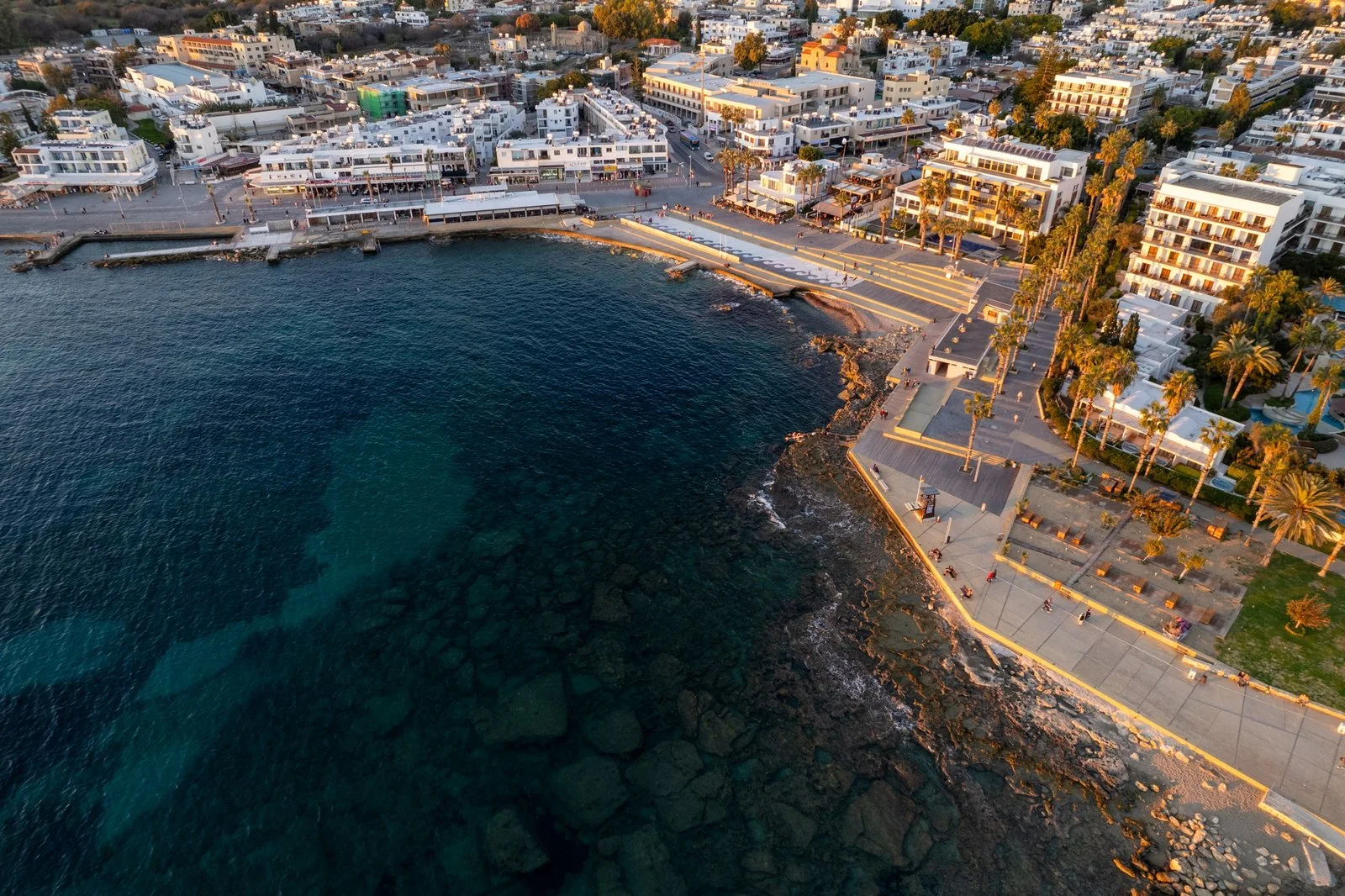
Kato ("lower") Paphos is the harbour district of Paphos, below the old upper town of Ktima. It mixes some of the island's most important ancient sites, including the Paphos Archaeological Park, a UNESCO World Heritage Site, with a seafront promenade, the medieval castle on the harbour and a busy restaurant scene.
Summer brings holidaymakers, but many people live here year-round: Cypriots, expats and long-term international residents, with a large community of British retirees as well as families, young professionals and remote workers.
Where is Kato Paphos and how do you get around?
| Destination | About |
|---|---|
| Paphos International Airport | 15 minutes by car |
| Coral Bay | 20 minutes by car |
| Limassol | 1 hour via the A6 |
| Nicosia | 1.5-2 hours, depending on traffic |
The harbour bus station is a hub for Paphos Buses, with routes to the airport, Coral Bay and the upper town. A daytime single ticket is €2 and a 30-day personalised pass €50. The flat seafront is easy to walk or cycle, but most residents still have a car for shopping and trips inland. More in our public transport guide.
Neighbourhoods and places in Paphos town
Paphos is really two towns joined by one long road. Kato Paphos sits by the sea around the harbour, and Ktima, the old upper town, is the everyday Cypriot centre on the ridge above. Apostolou Pavlou Avenue, the busiest road in town, runs about 2.6 km between them, from Kennedy Square down to the seafront. These are the parts residents talk about most.
The harbour and castle quarter
This is the postcard end of town: fishing boats, the small medieval fort at the end of the quay and a row of seafood tavernas. The castle began as a Byzantine fort, was rebuilt by the Lusignans in the 13th century and restored by the Ottomans, and the square in front of it hosts the Aphrodite Festival each September. The Paphos Archaeological Park, with its Roman mosaics, begins right behind the harbour, and the harbour bus station is the hub for buses to the airport, Coral Bay and the upper town.
It suits retirees and culture lovers who like to walk everywhere and don't mind summer crowds. Homes here are mostly older low-rise apartment blocks and holiday complexes, and one-bedroom flats are advertised at about €700–€950 a month (2026).
Tip: parking near the harbour is tight from June to September, so if you live nearby, walk or take the bus in.
Poseidonos Avenue and the seafront promenade
Poseidonos Avenue is the seafront road heading south-east from the harbour, lined with hotels, cafés and restaurants on one side and small sandy beaches on the other. Running alongside is the renovated coastal promenade, about 4 km of wide paved path with seating areas and viewpoints that was redone in a €7.5 million project. It is where much of Paphos goes for an evening walk or a morning run.
The beaches here are the town's family beaches. Vrysoudia A, just off Poseidonos Avenue, has calm, shallow water, lifeguards from April to October and a bus stop nearby. Vrysoudia B, Alykes, Pachyammos and Dimotika Bania (the municipal baths beach) were also on the 2026 Blue Flag list. Aphrodite Waterpark is off the same avenue.
It suits holiday-home owners, retirees and anyone who wants to step out of the door onto the sea. It is livelier and noisier in summer than in winter, when some seasonal businesses close.
Tip: flats with a sea view on Poseidonos often go to short-term lets, so start your long-term search early in spring or in the autumn.
Lighthouse Beach and the archaeological park edge
At the western end of Kato Paphos, beside the lighthouse and the archaeological park, is Lighthouse (Faros) Beach: about 400 m of golden sand with a Blue Flag, lifeguards from April to October, a children's playground and a beach volleyball court. The water can be wavier here than at Vrysoudia.
The streets behind are a mix of apartment complexes and hotels, quieter than the harbour but still within walking distance of it. It suits active people and families with older children.
Tip: the coastal path from here north towards the Tombs of the Kings is one of the nicest walks in town in the early morning.
Tombs of the Kings Avenue
North of the lighthouse, Tombs of the Kings Avenue runs up the coast past the rock-cut Tombs of the Kings necropolis, part of the Paphos UNESCO World Heritage Site, towards Chloraka and Coral Bay. It is a long strip of hotels, apartment complexes, cafés and shops. Aspire Private British School is on this road, and bus 615 runs from the Tombs of the Kings bus station through Chloraka to Coral Bay.
It suits people who want the sea and the buses close by but a little less bustle than the harbour. See our Universal and Tombs of the Kings guide for more.
Tip: traffic on the avenue backs up on summer evenings, so check how a flat's car park joins the main road before you sign.
Apostolou Pavlou Avenue, Fabrica Hill and Kings Avenue Mall
The middle stretch between the harbour and the old town is where many people do their shopping. Kings Avenue Mall, the main shopping centre in Paphos, has shops, restaurants and the town's multiplex cinema. Nearby are Fabrica Hill, a rocky outcrop dotted with ancient chambers and catacombs, and the Agia Solomoni catacomb, a small underground chapel with 12th-century wall paintings and a tree hung with offerings above it.
The American University of Beirut opened its Paphos campus in September 2024, a few hundred metres from the ancient sites of Nea Paphos, so there are now more students and young staff in this part of town.
Tip: if you want a flat between the sea and the old town, look at Universal, the residential area just off this corridor, where two-bedroom flats ask about €700–€950 a month (2026).
Ktima, the old town
Ktima is the administrative and commercial heart of Paphos, with a much more local feel than Kato Paphos. Its centre is Kennedy Square, renovated between 2015 and 2017 for Paphos's year as European Capital of Culture. Around it you'll find the leafy Municipal Garden behind the Town Hall, the Markideio Theatre, boutiques on Makariou Avenue, street murals and the revamped municipal market with its cafés. The District Archaeological Museum, with finds from the Neolithic to 1700 AD, is on Griva Digeni Avenue.
It suits people who want to live among Cypriot neighbours, use local services and pay less. Rents are among the lowest in town: about €550–€800 a month for a two-bedroom flat (2026). Many older flats and family houses here have no sea view, which is one reason they are cheaper.
Tip: Ktima is hillier than Kato Paphos, so if you rely on walking, choose a street close to Kennedy Square.
Mouttalos
Mouttalos is the old Turkish Cypriot quarter of Paphos, on the edge of the old town, surrounded by steep rock faces with large natural caves. Oral history says families sheltered in these caves during the intercommunal fighting of 1963–64. The municipality has been reshaping the area with EU co-funding, adding a pedestrian path along the rock, green spaces, benches and shade, with the aim of making it a place for walking and meeting.
It is a small, quiet residential pocket close to the old-town shops, and it suits people who like character over sea views.
Tip: walk the rock-side path at sunset for one of the better views over the lower town.
Map it · Walking route
A morning walk through Kato Paphos
- Paphos Castle
- Paphos Archaeological Park
- Lighthouse Beach
- Tombs of the Kings
Opens Google Maps with every stop in order. Opening hours can change, so check before you go.
Map it · Walking route
A stroll around Ktima, the old town
- Mouttalos
- Paphos Municipal Market
- Kennedy Square
- Municipal Garden
- Markideio Theatre
- District Archaeological Museum
Opens Google Maps with every stop in order. Opening hours can change, so check before you go.
Who is Kato Paphos best for?
Retirees
Flat, walkable streets, the promenade, cafés and an established English-speaking community.
Families
Beaches, parks and international schools within a short drive.
Remote workers
Cafés, sea views and a lower cost of living than Limassol.
Culture lovers
Roman mosaics, the Tombs of the Kings and the castle on your doorstep.
Homes and cost of living
Housing ranges from older low-rise apartment blocks and holiday complexes to modern sea-view flats and villas. Kato Paphos is one of the pricier parts of Paphos, but still well below Limassol: in mid-2026 average one-bedroom rents in Paphos were roughly half those in Limassol. Paphos apartment prices rose about 18.5% in the year to mid-2026, the fastest of any district.
Approximate asking prices as of October 2026:
| Home | Rent per month |
|---|---|
| One-bedroom apartment | €700-€950 |
| Two-bedroom apartment | €850-€1,300 |
| Three-bedroom townhouse or house | €900-€1,500 |
To buy, expect from about €150,000 for an older one-bedroom flat to over €1 million for a sea-view villa. Utilities for a medium apartment are about €150-€200 a month; a simple restaurant meal is about €12 and a mid-range dinner for two about €50.
Schools, healthcare and everyday services near Kato Paphos
Schools
- Aspire Private British SchoolTombs of the Kings Avenue, Kato Paphos: UK curriculum for ages 4 to 18, with IGCSE, GCSE and A levels.
- The International School of Paphos100 Aristotelous Savva Avenue, Anavargos: English National Curriculum from about age 2½ to 18, through to A levels.
- Nova SchoolsAnthipolochagou Georgiou Savva Street, Paphos: an English-language school with a British curriculum and Montessori, Steiner and Reggio Emilia influences, starting from nursery age.
- Lumio Private SchoolAcheleia, east of Yeroskipou, on the former American Academy campus: opened in September 2024 with a Cambridge International curriculum taught in English, and plans for the IB Diploma in the final two years.
- State secondary schools in town: Paphos Technical School on Anexartisias Avenue, with Nikolaideio Gymnasium, Agios Theodoros Gymnasium and Kykkos Lyceum of Paphos all within about 1 km of it in Ktima.
- State schools: places are allocated by home address, and lessons are in Greek. The Ministry of Education explains how state primary schools work, and its secondary education pages cover the gymnasium (ages 12 to 15) and lyceum (15 to 18).
See our international schools guide to compare fees and curricula.
Hospitals and clinics
- Paphos General HospitalAnavargos: the district's main public hospital, run by the State Health Services Organisation (OKYPY), with a 24-hour emergency department.
- Evangelismos Private Hospital87 Vasileos Konstantinou Avenue, Paphos: private hospital with a 24-hour casualty department.
- Iasis Private Hospital8 Voriou Ipirou Street, Paphos, in the Universal area.
- Elpis Medical Centre68 Agapinoros Street, Kato Paphos, the closest to the harbour.
- Blue Cross Medical Centre51 Dimokratias Avenue, Paphos.
- Royal Artemis Private Hospital2 Pavlou Crineou Street, Paphos.
- Family doctor: choose a personal doctor close to home and register through GESY, the national health system.
Shopping and services
- Supermarkets: Sklavenitis at 4 Lidas Street, Kato Paphos (a former Papantoniou store, converted in May 2025); Sklavenitis on Ellados Avenue; Sklavenitis inside Kings Avenue Mall; Lidl at 104 Tombs of the Kings Avenue and Lidl at 49 Alexandrou Ypsilanti Street; Alphamega at 87 Dimokratias Avenue, near the industrial area; and the Garden of Eden store at 13 Agapinoros Street. Our supermarkets guide compares the chains.
- Municipality: Kato Paphos and Ktima are run by Pafos Municipality, which was left unchanged by the 2024 reform.
- Citizen services: the Pafos Citizen Service Centre on Michail Savva Street, in the Stelios Kyriakides stadium car park, handles many government applications and enquiries (Monday to Friday, 8:00 to 13:15).
- Post: use the Cyprus Post website to find the nearest post office or postal agency and to track parcels.
- Buses: Pafos Buses (OSYPA) runs three town-centre hubs: the Harbour station next to the entrance to the archaeological site, Karavella station on Andrea Geroudi Street, and Tombs of the Kings station opposite McDonald's. Route 610 links the harbour with the municipal market, 611 runs from Tombs of the Kings via the harbour to Geroskipou Beach, 615 goes to Coral Bay, 618 links Karavella with Tombs of the Kings, and 612 and 613 serve the airport.
Things to do in and around Kato Paphos
Paphos Archaeological Park
The Roman villas and mosaics of the Houses of Dionysos and Theseus, the Odeon and the Saranta Kolones castle ruins. See our UNESCO sites guide.
Tombs of the Kings
Rock-cut tombs from the Hellenistic and Roman periods, a short walk or ride north along the coast.
The harbour and castle
Fishing boats, boat trips, and the small medieval fort at the end of the quay. Our boat trips guide has the options.
Beaches
Lighthouse Beach and the town beaches along the promenade, or drive 20 minutes to Coral Bay.
Eat out
Seafood by the harbour, plus our guides to the best restaurants, brunch and Asian food in Paphos.
Day trips
The Akamas peninsula, the wine villages of the Laona plateau, or the Troodos mountains. Ideas in 12 things to do in Paphos.
Pros and cons of living in Kato Paphos
Pros:
- Sea, promenade and historic sites on your doorstep
- Walkable and flat
- Cheaper than Limassol
- Large English-speaking community
Cons:
- Busy and touristy in summer
- Some streets feel quiet out of season
- Prices have risen fast since 2024
- Fewer big-city jobs than Limassol or Nicosia
Nearby options: Universal, Chloraka and Yeroskipou. Compare more with our area finder or the Paphos guide.
Plan my trip
Want us to plan your days in Cyprus?
Tell us where you’re going, for how many days and what you love. We’ll send you a plan made for you, with places to see, where to eat and a Google Maps route for each day.
Compare other areas in Paphos
Recommended for this guide
Contains affiliate links Booking.com
Frequently asked questions
How far is Kato Paphos from the airport?
About 15 minutes by car. Coral Bay is about 20 minutes away and Limassol about an hour via the A6.
Who lives in Kato Paphos?
Local Cypriots, expats and long-term international residents. British retirees form a significant group, and families, young professionals and digital nomads also live there.
How much is rent in Kato Paphos?
As of October 2026, asking rents are around €700-€950 a month for a one-bedroom apartment, €850-€1,300 for a two-bedroom and about €900-€1,500 for a three-bedroom house.
Is Kato Paphos cheaper than Limassol?
Yes. In mid-2026 average one-bedroom rents in Paphos were roughly half those in Limassol, although Kato Paphos is one of the pricier parts of Paphos.
What is the difference between Kato Paphos and Ktima?
Kato Paphos is the seaside harbour district with the archaeological park, beaches and most hotels. Ktima is the old upper town around Kennedy Square, the administrative and shopping centre, with a more local feel and lower rents. Apostolou Pavlou Avenue links the two.
Which beaches are in Paphos town?
Lighthouse (Faros) Beach by the archaeological park, and Vrysoudia A and B, Alykes, Pachyammos and Dimotika Bania along Poseidonos Avenue. All were on the 2026 Blue Flag list.
Is Kato Paphos good for expats?
Yes. It offers sea access, culinary variety, cultural heritage and a welcoming community.
Which hospitals and schools are near Kato Paphos?
Paphos General Hospital in Anavargos is the public hospital, with a 24-hour emergency department, and Evangelismos, Iasis, Blue Cross and Elpis are private options in town. Aspire Private British School is on Tombs of the Kings Avenue, and the International School of Paphos is in Anavargos.
Useful links
- Visit Cyprus – Vrysoudia A Beach – Blue Flag
- Visit Cyprus – Faros Beach, Pafos – Blue Flag
- Visit Cyprus – Agia Solomoni Christian Catacomb
- Visit Cyprus – Archaeological Museum of the Pafos District
- Remodelling – highlighting spaces in the Mouttalos area – Paphos Municipality
- Private primary schools in Cyprus – Ministry of Education
Sources (31)
- Apartments for rent in Paphos: 2026 guide – INDEX.cy
- Houses for rent in Paphos: 2026 guide – INDEX.cy
- Limassol remains Cyprus' most expensive city for renters (23 July 2026) – Cyprus Mail
- Cyprus property market sees 8.5% price growth in Q2 2026 (Central Bank RPPI) – INDEX.cy
- Tickets and fares – Pafos Transport Organisation (pafosbuses.com)
- Sklavenitis – Wikipedia
- Paphos – Wikipedia
- Apostolou Pavlou Avenue – Wikipedia
- Vrysoudia A Beach – Blue Flag – Deputy Ministry of Tourism (visitcyprus.com)
- Faros Beach, Pafos – Blue Flag – Deputy Ministry of Tourism (visitcyprus.com)
- Agia Solomoni Christian Catacomb – Deputy Ministry of Tourism (visitcyprus.com)
- Archaeological Museum of the Pafos District – Deputy Ministry of Tourism (visitcyprus.com)
- Remodelling – highlighting spaces in the Mouttalos area – Paphos Municipality
- A journey through time: Paphos old town – Commercial.cy (17 November 2023)
- Newly renovated Kato Paphos promenade – The Villa Group (11 November 2023)
- Phedonos hails new university campus in Paphos – Cyprus Mail (4 September 2024)
- Private primary schools in Cyprus – Ministry of Education
- Private secondary schools in Cyprus – Ministry of Education
- List of hospitals in Cyprus (updated 24 June 2026) – GOV.UK
- Paphos General Hospital – State Health Services Organisation
- Main bus stations and routes – Pafos Buses (OSYPA)
- The best supermarkets in Paphos (updated January 2026) – Guide to Paphos
- Sklavenitis Cyprus renovation and integration plan for Papantoniou stores (17 June 2025) – CBN
- Pafos Citizen Service Centre – Pafos Municipality
- Aspire school – Cyprus Mail schools guide
- The International School of Paphos – about the school
- Nova Private Alternative Primary English School – INDEX.cy places
- Lumio Private School officially opens in Paphos (5 October 2024) – CBN
- Paphos Technical School – WhatSchool
- Evangelismos Private Hospital – Cyprus Mail healthcare guide
- Buses in Paphos: the comprehensive guide (updated May 2026) – Guide to Paphos