Summarise this page 5 key points · 1 minute
- What birds can you see in Cyprus in winter?Winter visitors start arriving in October and duck numbers climb through the season.
- Where are the best winter birdwatching sites with hides?Oroklini Lake, just off the Larnaca–Ayia Napa motorway at Voroklini, is one of only seven natural wetlands in Cyprus, and about 190 bird species have been recorded there.
- How do you join BirdLife Cyprus?BirdLife Cyprus is the island's bird conservation charity and the national partner of BirdLife International.
- When is the hunting season, and how does it affect birdwatching?Hunting in Cyprus takes place on Wednesdays and Sundays.
- What etiquette and rules should you know?Birders have been questioned near army camps, at Akrotiri and around Paphos airport, and cameras have been confiscated.
Quick answer
Winter is the best time to watch waterbirds in Cyprus: from about November to March flamingos, ducks, herons and waders gather on the island's wetlands. The easiest places with hides or viewing points are Larnaca Salt Lake, Oroklini Lake, Athalassa Park in Nicosia and the Akrotiri wetlands near Limassol, which sit inside the British Sovereign Base Area. BirdLife Cyprus runs guided field trips, free for members, and you should plan countryside walks around the Wednesday and Sunday hunting days.
- Flamingos usually winter in Cyprus from about November to March; the Game and Fauna Service puts the average at 5,000 to 10,000 birds across the main wetlands.
- Oroklini Lake near Larnaca has a bird hide and information kiosk built by an EU LIFE project run by the Game Fund with BirdLife Cyprus (2012–2014).
- Akrotiri flamingo numbers fell from about 13,000 in 2020 to about 200 in 2025, while Larnaca Salt Lake and Paralimni Lake gained birds.
- The Cyprus warbler can be seen all year, but the Cyprus wheatear is in Africa from about November to February.
- Hunting takes place on Wednesdays and Sundays; the 2026–27 winter dates had not been published as of October 2026.
The best birdwatching in Cyprus happens in winter, when rain fills the salt lakes and flamingos, ducks, herons and waders arrive from colder countries. You can see most of it from hides and viewing points at Oroklini Lake, Larnaca Salt Lake, Athalassa Park in Nicosia and the Akrotiri wetlands near Limassol, all within half an hour of a main town. Go on a weekday or a reserve site if you want to avoid the hunting days, which are Wednesdays and Sundays.
Below we cover where to go, what you can realistically see between November and February, how to join a guided trip with BirdLife Cyprus, and the rules that catch newcomers out, especially around military areas.
What birds can you see in Cyprus in winter?
Winter visitors start arriving in October and duck numbers climb through the season. The main groups to look for:
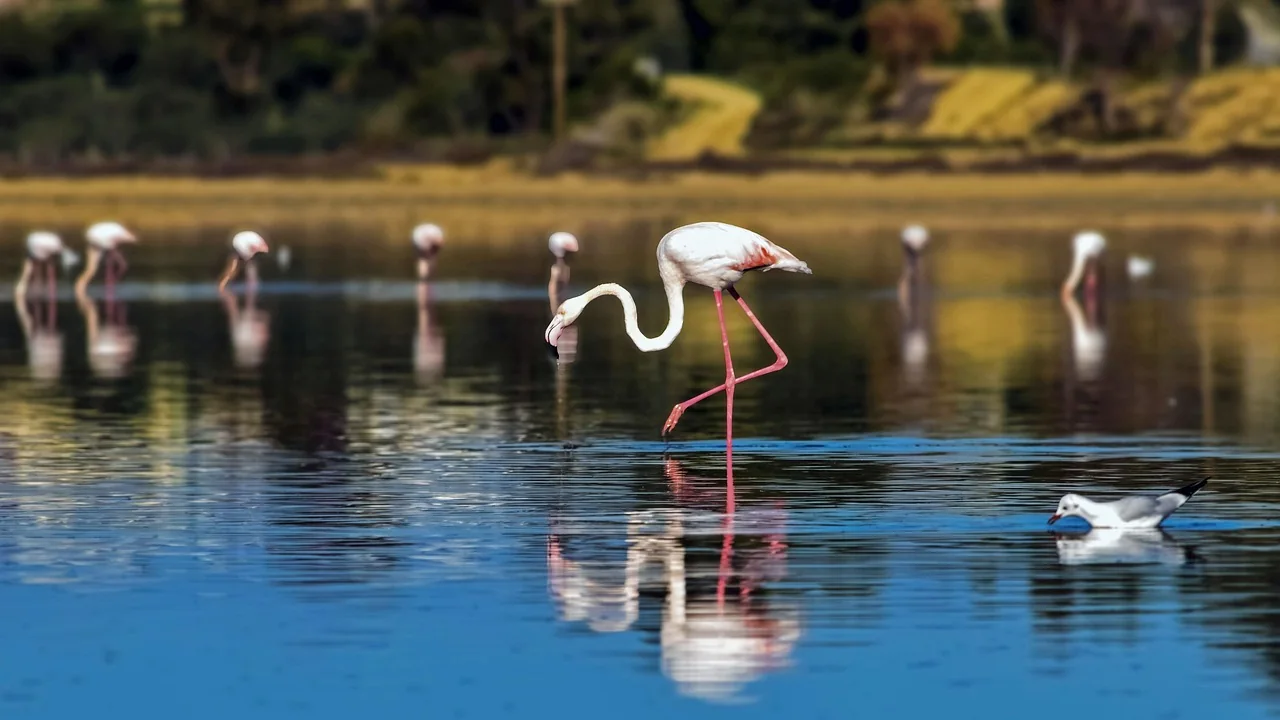
- Greater flamingos. The headline act. In December 2025 a senior Game and Fauna Service officer said that 5,000 to 10,000 flamingos winter on the island's wetlands in an average year, mainly at Akrotiri, Larnaca Salt Lake, Paralimni Lake and Oroklini Lake. Monthly counts show numbers have fallen by up to 31% over the past decade, which officials link to drought and poor water quality.
- Ducks and geese. Shoveler, teal, wigeon, pintail and pochard, plus a small flock of white-fronted geese that winters on the island.
- Herons, egrets and waders. Grey heron, little and great white egret, golden plover, lapwing and, on the coast, greater sand plover and turnstone.
- Small birds in reeds and scrub. Bluethroat and reed bunting in marshes; black redstart, robin, stonechat and song thrush almost everywhere.
- Birds of prey. Marsh and hen harriers over wetlands and fields, peregrine, and the resident Bonelli's eagle in hill country such as Paphos Forest, the Akamas and the Diarizos Valley.
- Specialities. Finsch's wheatear at Asprokremmos and Cape Greco, and the rare wallcreeper on cliffs and gorges.
The endemics, and one common mistake. Cyprus has three bird species that breed nowhere else: the Cyprus warbler, the Cyprus wheatear and the Cyprus scops owl. The Cyprus warbler can be seen all year in scrub across the island. The Cyprus wheatear, however, is only here from March to October and spends the winter in Africa, so do not plan a December trip around it.
What about cranes? The big crane movements are an autumn event: demoiselle cranes pass through Akrotiri in late August and early September, and common cranes roost there in October and November. By mid-winter most have gone south.
Where are the best winter birdwatching sites with hides?
| Site | Area | What is there | Winter highlights | More information |
|---|---|---|---|---|
| Oroklini (Voroklini) Lake | Larnaca | Bird hide, information kiosk, fenced reserve | Herons, flamingos, glossy ibis, spur-winged lapwing | Larnaka Tourism Board |
| Larnaca Salt Lake | Larnaca | 4 km nature trail with a bird-watching tower | Flamingos, gulls, ducks | Our flamingo guide |
| Akrotiri Salt Lake and Zakaki | Limassol (SBA) | Observation area at the Environmental Education Centre; hide at Zakaki | Flamingos, ducks, harriers | Akrotiri Environmental Education Centre |
| Athalassa National Forest Park | Nicosia | Hide by the lake | Ducks, egrets, herons, woodcock | BirdLife Cyprus events |
| Paralimni Lake | Famagusta district | Open shore; BirdLife winter events | Flamingos, ducks | BirdLife Cyprus |
| Asprokremmos Dam and Mandria | Paphos | Tracks and viewpoints | Finsch's wheatear, golden plover, lapwing | BirdLife site guide (PDF) |
Oroklini Lake, Larnaca
Oroklini Lake, just off the Larnaca–Ayia Napa motorway at Voroklini, is one of only seven natural wetlands in Cyprus, and about 190 bird species have been recorded there. Between 2012 and 2014 an EU LIFE project led by the Game Fund, with BirdLife Cyprus, the Department of Environment, the Forestry Department and Voroklini Community Council, fenced the lake against cars and dogs, managed its water levels, created nesting islets and built a bird hide and information kiosk. In 2018 it won a "Best LIFE project" award from the EU. In winter, look for herons, flamingos and glossy ibis. It is small, so an hour is enough, and it pairs well with the Larnaca Salt Lake on the same morning.
Larnaca Salt Lake and the sewage works pools
We cover the flamingos, the nature trail and Hala Sultan Tekke in our Larnaca Salt Lake guide. For birders, the key points are the bird-watching tower on the main lake, Aliki, and the fact that Larnaca has gained flamingos in recent years while Akrotiri has lost them. A short drive south, the Larnaca sewage works pools near Meneou have a Forestry Department hide and seasonal Spiro's Pool nearby, good for wintering ducks such as shoveler and teal. BirdLife Cyprus has run several field trips there, often combined with Oroklini.
Akrotiri wetlands, Limassol
Akrotiri is the largest wetland complex in Cyprus and a Ramsar wetland of international importance since 2003, covering about 2,171 hectares. It lies inside the Western Sovereign Base Area, which is British territory, so some tracks and areas are closed to the public. It includes the salt lake, Lady's Mile, Fasouri reed beds and Zakaki Marsh (also called Makria Lake) near Limassol's new port, which has a hide.
Be aware that Akrotiri is going through a bad patch. Flamingos at the salt lake fell from about 13,000 in 2020 to about 200 in 2025, and by July 2026 polluted water had let reeds swamp the Zakaki hide. BirdLife Cyprus has raised funds to clear reeds in front of the hide and create a nesting island, with work expected from September 2026, so check how far it has got before you go.
The easiest starting point is the Akrotiri Environmental Education Centre on Queen Elizabeth Street in Akrotiri village, which has telescopes and binoculars trained on the salt lake, exhibitions, a botanic garden and wheelchair access. Entry is free. The SBA Administration lists it as open Monday to Friday, 07:30 to 13:30, and closed at weekends and on public holidays (checked October 2026), so a weekday visit is best.
Athalassa National Forest Park, Nicosia
The lake at Athalassa is Nicosia's largest and most important wetland, used by more than 170 species. There is a hide on the lake shore on the General Hospital side of the park. In winter look for shoveler, pintail, wigeon and ferruginous duck, egrets and herons, and woodcock in the woods. It is the easiest site for anyone living in Nicosia, and BirdLife Cyprus has a field trip there on 24 October 2026.
Paphos: Asprokremmos, Mandria and the headland
In the Paphos district, the best sites are Asprokremmos Dam near Timi for wildfowl and Finsch's wheatear (some tracks need a four-wheel drive), the farmland at Mandria for golden plover, lapwing and harriers, and Paphos headland by the lighthouse for waders such as golden plover and turnstone. BirdLife ran a trip at Asprokremmos and Mandria in April 2024 and another from the archaeological park entrance by Paphos Lighthouse in March 2026. If you live further east, Achna Dam near the buffer zone usually holds water all winter; take ID and avoid pointing optics at the military posts there.
How do you join BirdLife Cyprus?
BirdLife Cyprus is the island's bird conservation charity and the national partner of BirdLife International. It was formed in 2003 by merging the two older Cyprus Ornithological Societies (one from 1957, popular with British birders, and one from 1970, mainly Cypriot). It has more than 500 members.
Membership fees, as of October 2026, from the membership page:
| Package | Who it covers | Yearly fee |
|---|---|---|
| Single | 1 adult | €30 |
| Joint | 2 adults | €35 |
| Family | 1–2 adults and up to 3 children | €40 |
| Junior | 1 child up to 18 | €10 |
Members get the Cyprus Wheatear magazine twice a year, the e-newsletter and monthly checklist, and free places on field trips. Non-members are welcome too: for the October 2025 Larnaca Salt Lakes trip, BirdLife charged non-members €10, with members and under-12s free, and booking was required. Each winter BirdLife also holds a free family World Wetlands Day morning at Paralimni Lake with telescopes and binoculars to borrow (on 2 February 2025 and 1 February 2026). Watch the events page for the 2027 date; it had not been announced as of October 2026.
When is the hunting season, and how does it affect birdwatching?
Hunting in Cyprus takes place on Wednesdays and Sundays. In 2025–26 the season for resident game (hare, partridge, francolin) ran from 2 November to 28 December, followed by migratory thrushes from late December into February. The Game and Fauna Service had not published the 2026–27 winter dates by late October 2026, so look for its announcement, usually in late October.
What this means in practice:
- Plan farmland and hill walks for other days. Wetland reserves, Athalassa Park and the education centre at Akrotiri are fine on any day.
- Wear something bright and stay on paths during the season.
- Expect early starts. Residents near hunting areas complain about shots from dawn on hunting days.
- Report illegal trapping or shooting to the Game and Fauna Service or the police; BirdLife Cyprus publishes a list of who to contact.
What etiquette and rules should you know?
- Military areas. Birders have been questioned near army camps, at Akrotiri and around Paphos airport, and cameras have been confiscated. Do not photograph or scan near camps, masts or airports, and obey "No photography" signs. Carry ID at Akrotiri and Achna.
- Stay out of the lakes. Wading into Larnaca Salt Lake is prohibited, and getting closer anywhere pushes birds off.
- Keep dogs on a leadOroklini was fenced precisely because dogs and cars disturbed nesting birds.
- Use the hides and talk quietly; do not play bird calls.
- Mud and snakes. Wear boots and long trousers near water and scrub.
What to do next
- Pick a weekday morning and start with Oroklini and Larnaca Salt Lake, or the Akrotiri centre if you live in Limassol.
- Join BirdLife Cyprus or book a field trip on its events page, where guides bring telescopes and help with identification.
- Turn the outing into a longer day with our winter plans for December to February, a walk from our best hiking trails list on a non-hunting day, or more wild places in waterfalls and nature spots in Cyprus.
- Heading for the hills instead? Our Kakopetria and Galata winter weekend guide covers the Troodos side of winter.
Recommended for this guide
Contains affiliate links GetYourGuide
Frequently asked questions
When is the best time to see flamingos in Cyprus?
Usually from November to March, once winter rain has filled the salt lakes. Numbers change a lot from year to year with rainfall and water quality.
Where are the bird hides in Cyprus?
Oroklini Lake has a hide and information kiosk, Athalassa National Forest Park in Nicosia has a hide by the lake, Larnaca Salt Lake has a bird-watching tower on the nature trail, and the Akrotiri Environmental Education Centre has a wildlife observation area with telescopes.
Is it safe to go birdwatching during the hunting season in Cyprus?
Yes, if you plan around it. Hunting is allowed on Wednesdays and Sundays in season, so choose wetland reserves, parks or other days for countryside walks, wear bright clothing and keep to paths.
Can I see the Cyprus wheatear in winter?
No. It is in Cyprus from March to October and winters in Africa. The Cyprus warbler, the other endemic songbird, can be seen all year in scrub.
How much does BirdLife Cyprus membership cost?
As of October 2026, €30 a year for one adult, €35 for two adults, €40 for a family and €10 for a junior. Members join field trips free; in 2025 non-members paid €10.
Can I go birdwatching at Akrotiri?
Yes, but Akrotiri is in the British Sovereign Base Area, so some areas are off limits. Carry ID, follow military signs and do not point cameras or binoculars at military installations.
Useful links
- BirdLife Cyprus – Become a memberMembership from €10 (junior) to €40 (family) a year
- BirdLife Cyprus – Events and field tripsGuided birdwatching mornings; booking required
- BirdLife Cyprus – Where to watch birds (site guide PDF)
- Akrotiri Environmental Education Centre (SBA Administration)Weekdays only; telescopes over the salt lake
- Larnaka Tourism Board – Bird watchingOroklini Lake, Larnaca Salt Lake, Cape Kiti
- Visit Cyprus – Akrotiri Environmental Education and Information Centre
- BirdLife Cyprus – Birdwatching in Cyprus (seasons and safety)
Sources (17)
- BirdLife Cyprus – Birdwatching in Cyprus (checked 19 October 2026)
- BirdLife Cyprus – Where to watch birds in Cyprus (site guide)
- BirdLife Cyprus – Become a member (fees checked 19 October 2026)
- BirdLife Cyprus – Events listing (checked 19 October 2026)
- BirdLife Cyprus – Larnaca Salt Lakes field trip, 11 October 2025
- BirdLife Cyprus – World Wetlands Day at Paralimni Lake, 1 February 2026
- BirdLife Cyprus – Cyprus warbler, Cyprus wheatear and Bonelli's eagle species pages
- BirdLife Cyprus – Our history
- BirdLife Cyprus – Hunting
- European Commission LIFE – Restoration and management of Oroklini Lake SPA (LIFE10 NAT/CY/000716)
- Ramsar Sites Information Service – Akrotiri (site no. 1375)
- SBA Administration – Akrotiri Environmental Education Centre (checked 19 October 2026)
- Larnaka Tourism Board – Bird watching
- Cyprus Mail – First flamingos reach Cyprus, fewer expected this year (8 December 2025)
- Politis – Akrotiri wetland restoration project to begin (7 July 2026)
- Cyprus Mail – Hunters on the decline but complaints on the increase (1 February 2026)
- Cyprus Mail – 36,000 expected to head out hunting on Sunday (1 November 2025)