Summarise this page 9 key points · 1 minute
- Long-term let or holiday let: which rules apply?The line is drawn by how you let, not by the property.
- How do you register a holiday let with the Deputy Ministry of Tourism?Every villa, house or apartment let short-term must be entered in the Register of Self-Service Accommodation before it is advertised or let.
- How is rental income taxed in Cyprus in 2026?The tax reform that took effect on 1 January 2026 simplified landlord tax.
- Do you need to stamp or register the lease?Stamp duty: abolished from 1 January 2026.
- What should a landlord put in the contract?Our tenant guide lists what every lease should cover.
- Should you use a letting agent?Anyone who finds tenants for a fee must be licensed under the Real Estate Agents Law 71(I)/2010, renew that licence every year and carry €200,000 of professional insurance.
- What insurance do landlords need?Mortgage lenders require buildings cover, and advisers who handle holiday-let registrations list fire and public liability cover among the documents.
- What if you live outside Cyprus?Non-resident owners are taxed in Cyprus on Cyprus rent at the same personal bands, with no defence contribution.
- Long-term or holiday let: which pays more?Long-term rents keep rising: the RICS and KPMG index showed apartment rents up 7.36% a year in the second quarter of 2026, and Bazaraki asking rents for January to August 2026 averaged €1,716 a month in Limassol, €1,131 in…
Quick answer
You can let a Cyprus home long-term without any licence, but a holiday or short-term let must first be registered with the Deputy Ministry of Tourism (€222, valid three years) and its registration number shown in every listing. From 2026, rent is no longer subject to defence contribution: individual landlords pay income tax on rent after a 20% deduction, plus 2.65% GESY on the gross rent, and short-term lets are taxed as business income with VAT at 9% above €15,600 a year. Lease contracts no longer need stamping, and since 1 July 2026 all rent must be paid electronically.
- Holiday lets must be in the Deputy Ministry of Tourism's register before you advertise; letting unregistered can bring a fine of up to €5,000, up to a year in prison, or both.
- Since 20 May 2026 an EU regulation makes platforms such as Airbnb and Booking.com collect and check your registration number and share data with the authorities.
- Long-term rent: income tax at the personal bands after a 20% deduction on gross rent from buildings, plus GESY at 2.65%; special defence contribution on rent was abolished from 1 January 2026.
- Stamp duty was abolished from 1 January 2026, and only leases longer than 15 years can be registered at the Land Registry.
- Non-resident owners are still taxed in Cyprus on Cyprus rent and need a Cyprus tax number and an annual return.
You can let your Cyprus property to a long-term tenant without any licence, but a holiday let must be registered with the Deputy Ministry of Tourism before you advertise it. Either way, the rent is taxable in Cyprus: from 2026 that means income tax after a 20% deduction plus 2.65% GESY, with no defence contribution, and every payment must now arrive electronically.
This guide is for owners. If you are the tenant, read our guide to renting in Cyprus: contracts, deposits and tenant rights instead. It is general information, not tax or legal advice.
Long-term let or holiday let: which rules apply?
The line is drawn by how you let, not by the property. A home let for months to someone who lives there is an ordinary tenancy. A villa or flat let night by night to tourists, usually through Airbnb or Booking.com, is a "self-service (sharing economy) accommodation establishment" under the hotels and tourist accommodation law, and must be registered.
| Long-term let | Holiday or short-term let | |
|---|---|---|
| Permission needed | None | Registration with the Deputy Ministry of Tourism |
| Income tax | Personal bands after a 20% deduction on gross rent | Usually taxed as business income: receipts less actual expenses |
| GESY | 2.65% on the rent | Applies; the rate depends on how the income is classed |
| VAT | Exempt | 9% once turnover exceeds €15,600 in 12 months |
| Contract | Written lease; no stamp duty from 2026 | Booking terms; guests are not tenants |
| Payment | Electronic only since 1 July 2026 | Electronic only |
Before choosing, check whether your building's registered regulations or your sale contract restrict holiday letting, and remember that the owners' committee will still bill you, not your guests or tenants. See communal fees in Cyprus apartments.
How do you register a holiday let with the Deputy Ministry of Tourism?
Every villa, house or apartment let short-term must be entered in the Register of Self-Service Accommodation before it is advertised or let. You receive a registration number and a special label, and the number must appear in every advert and listing.
Step by step
- Get a Cyprus tax number (TIN) if you do not have one; see how to get a Cyprus TIN.
- Insure the property. Advisers who handle registrations list fire cover and public liability insurance among the documents.
- Gather the documents. Owners and agents report that the Deputy Ministry asks for the title deed and/or the building or planning permit, a recent electricity bill showing the premises number, your ID (or company certificate), your TIN and VAT details where relevant, the insurance policy, and the owner's written authority if someone else runs the let.
- Apply online through the gov.cy service Apply to register self-service accommodation establishments, which takes the form of a solemn declaration.
- Pay the fee of €222 (2024 official notice, still the figure quoted in 2026).
- Add the number to your listings. Airbnb has a dedicated field for it; Booking.com and other platforms ask for it too.
A first registration is valid for three years. Renew online within the three months before expiry and the renewal runs for five years. Miss that window and you must start again as a new applicant with every document. Letting without a valid registration is an offence carrying up to €5,000 in fines, up to a year in prison, or both, plus up to €200 a day if it continues after conviction.
What changed in 2026?
- EU platform rules: since 20 May 2026, Regulation (EU) 2024/1028 requires platforms to collect hosts' registration numbers, check them and share activity data with national authorities. Listings without a valid number are easier to spot and remove.
- Audit findings: in July 2026 the Audit Office reported that, in a small sample, only 6 of 20 self-catering listings showed a valid matching registration. The register held 8,464 licensed properties on 6 May 2026.
- New law in preparation: the Deputy Ministry says it is drafting legislation that would add safety certificates and on-site inspections. No bill had been passed by November 2026. An earlier plan to cap owners at two units was blocked by the Legal Service in 2025.
How is rental income taxed in Cyprus in 2026?
The tax reform that took effect on 1 January 2026 simplified landlord tax. See our 2026 tax reform guide for the wider changes.
Long-term lets
- No defence contribution: special defence contribution (SDC) on rent, previously an effective 2.25% of gross rent for Cyprus-domiciled residents, is abolished. Company tenants no longer withhold it.
- Income tax: your rent is added to your other income and taxed at 0% up to €22,000, then 20%, 25%, 30% and 35% above €72,000.
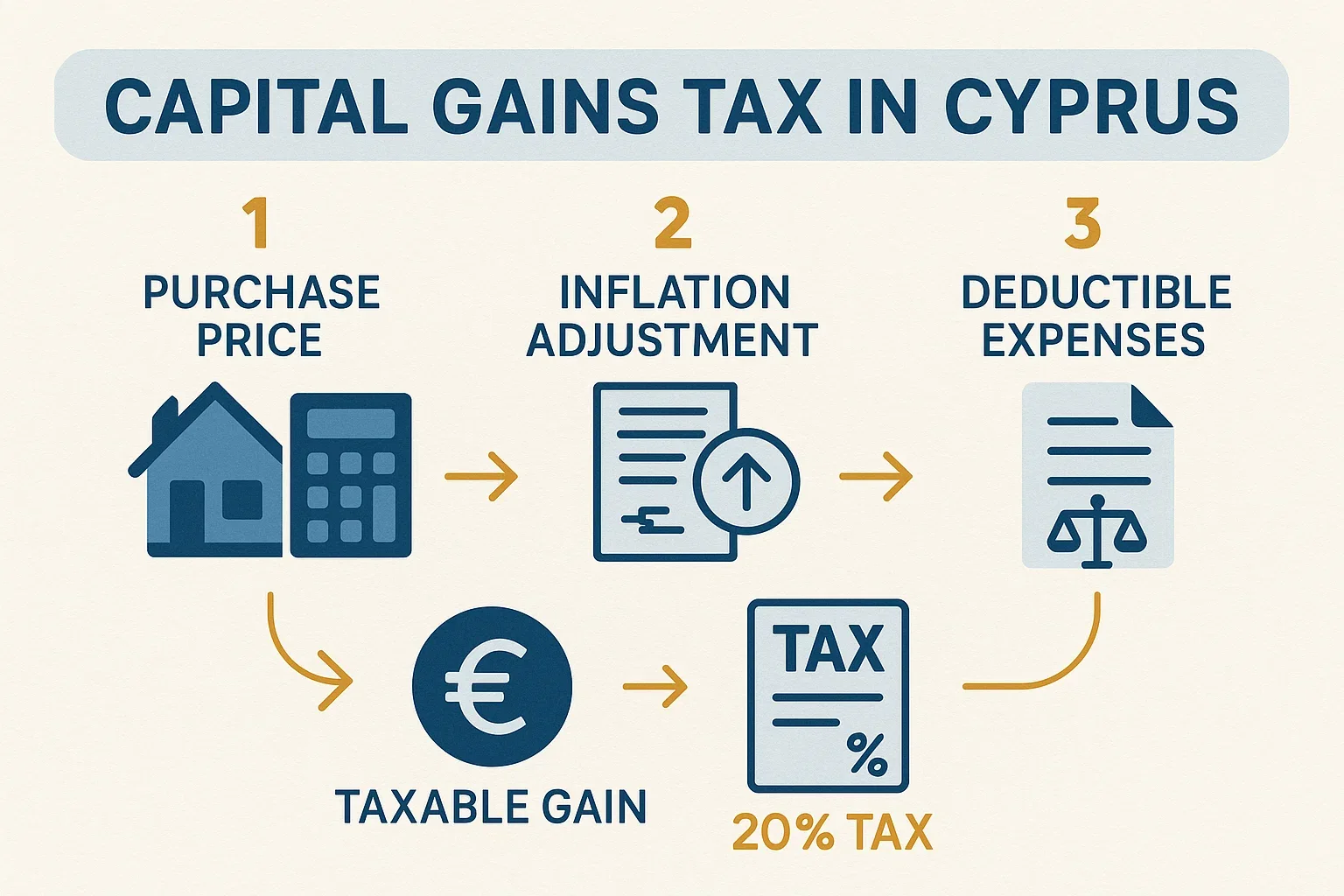
- Deductions: 20% of gross rent from buildings is deducted automatically for repairs and wear and tear, with no receipts needed. You can also deduct interest on a loan used to buy the let property and claim capital allowances on the building (not the land).
- GESY: individual landlords pay the health-system contribution at 2.65% on the rent, within the overall €180,000 income cap. If your tenant is an individual you pay it yourself through Tax For All by 30 June and 31 December for each half-year; a Cyprus company tenant deducts it at source.
- Filing: declare the rent on your annual return (TD1). For 2026 income the deadline is 31 July 2027; see our 2027 tax deadlines.
A simple example: €1,200 a month gives €14,400 a year. After the 20% deduction, €11,520 is added to your taxable income, and GESY is about €382.
Holiday lets
Income from registered short-term lets is generally treated as business income. You are taxed on receipts less actual costs such as platform commission, cleaning, utilities, insurance, repairs, management fees, loan interest and capital allowances. GESY also applies; ask your accountant which rate, because business income can attract the self-employed rate rather than 2.65%. Short-term accommodation is subject to VAT at 9%, and registration with the Tax Department is compulsory once this turnover passes €15,600 in any 12 months. A good accountant is worth the fee here; see how to choose an accountant in Cyprus.
No more cash rent
Since 1 July 2026, the Assessment and Collection of Taxes Law forbids landlords to accept rent other than by bank transfer, card or another recognised electronic method, whatever the amount. Under the reform, landlords who take cash lose the 20% deduction and other reliefs. Use one bank account for all rent, so your statements double as your records.
Do you need to stamp or register the lease?
- Stamp duty: abolished from 1 January 2026. Only contracts signed by at least one party before then fall under the old rules.
- Land Registry: there is no national register of residential tenancies. Only leases longer than 15 years can be registered with the Department of Lands and Surveys, which gives the tenant a real right over the property.
- Rent control: the Rent Control Law covers homes in controlled areas completed by 31 December 1999 once the original contract ends and the tenant stays on. Increases for those statutory tenancies are capped at 6% for 22 April 2025 to 21 April 2027, and recovering the property needs specific grounds and the Rent Control Court. Newer homes are let on free-market terms.
What should a landlord put in the contract?
Our tenant guide lists what every lease should cover. From the owner's side, make sure it also includes:
- The bank account for rent, so electronic payment is built in.
- Who pays communal fees, electricity, water and refuse charges; transfer the EAC account to the tenant where you can.
- A deposit clause. There is no legal cap and no state protection scheme; one to two months' rent is usual. Say when it is returned and what may be deducted.
- A signed, photographed inventory with meter readings.
- Rent review, notice periods and any break clause.
- Rules on pets, sub-letting and short-term sub-letting by the tenant.
Remember that you cannot evict without a court order. For anything beyond a standard lease, use a lawyer; see finding an English-speaking lawyer.
Should you use a letting agent?
Anyone who finds tenants for a fee must be licensed under the Real Estate Agents Law 71(I)/2010, renew that licence every year and carry €200,000 of professional insurance. Check the name in the register of agents before signing. Fees are not set by law, so agree in writing whether you pay a one-off letting fee, a monthly management fee or both, and what management covers: rent collection, repairs, check-outs, cleaning and guest handover for holiday lets.
What insurance do landlords need?
Mortgage lenders require buildings cover, and advisers who handle holiday-let registrations list fire and public liability cover among the documents. Tell the insurer the property is let, because tenant damage is a standard exclusion, and consider lost-rent cover. From 2026 you can deduct up to €500 a year of premiums for cover against natural disasters. Our home insurance guide compares policies.
What if you live outside Cyprus?
Non-resident owners are taxed in Cyprus on Cyprus rent at the same personal bands, with no defence contribution. Most advisers, including RSM and AGPLAW, say non-residents also pay GESY at 2.65% on that rent; confirm your position with your accountant. You need a Cyprus TIN, access to Tax For All and a return each year, and a local bank account makes electronic rent simple; see banks in Cyprus for expats.
- UK owners: HMRC also taxes UK residents on overseas rent, with credit for Cyprus tax under the UK–Cyprus double tax treaty.
- EU owners: your home country will usually tax the rent too, with relief under its treaty with Cyprus.
- Non-EU owners living in Cyprus: if your residence permit does not allow work, ask a lawyer whether running an active holiday-let business fits its conditions.
Long-term or holiday let: which pays more?
Long-term rents keep rising: the RICS and KPMG index showed apartment rents up 7.36% a year in the second quarter of 2026, and Bazaraki asking rents for January to August 2026 averaged €1,716 a month in Limassol, €1,131 in Paphos and €905 in Larnaca. As a rough guide (October 2026), a €100-a-night holiday let needs about 192 booked nights a year, before VAT, to match a €1,200 monthly tenancy. With tourist arrivals down 5.6% to September 2026, some owners are switching back to long lets.
What to do next
- Holiday let: register through the Deputy Ministry of Tourism before your first listing.
- Get your Cyprus TIN and log in to Tax For All.
- Diary the GESY dates and your 2026 tax return.
- Send tenants to our renting in Cyprus guide and our advice on rental scams.
Frequently asked questions
Do I need a licence to rent out my apartment in Cyprus?
Not for a long-term let to a tenant who lives there. For holiday or short-term lets you must register the property in the Deputy Ministry of Tourism's register of self-service accommodation and show the registration number in every advert.
How much tax do I pay on rental income in Cyprus in 2026?
Rent is added to your other income and taxed at 0% up to €22,000, then 20% to 35%. You deduct 20% of the gross rent from buildings and any interest on the loan used to buy the property. You also pay GESY at 2.65% on the rent. Defence contribution on rent no longer applies from 2026.
How much does Airbnb registration cost in Cyprus?
The Deputy Ministry of Tourism charges €222. A first registration is valid for three years; a renewal filed online in the three months before expiry is valid for five years.
Do I have to charge VAT on a holiday let in Cyprus?
Short-term accommodation is taxable at the reduced 9% rate, and you must register for VAT once your turnover from it exceeds €15,600 in any 12 months. Long-term residential lets are exempt from VAT.
Does a rental contract in Cyprus still need stamp duty?
No. The Stamp Duty Law was repealed from 1 January 2026. Contracts signed by at least one party before that date stay under the old rules.
Do non-residents pay tax on Cyprus rental income?
Yes. Rent from Cyprus property is taxed in Cyprus whether or not you live there, and most advisers say non-residents also pay GESY at 2.65% on it. Your home country may tax it too, usually with credit for the Cyprus tax.
Useful links
- Deputy Ministry of Tourism – Apply to register self-service accommodationOnline application for a holiday-let registration number
- Deputy Ministry of Tourism – Renewing a self-service registrationRenew online in the three months before expiry
- Tax Department – Tax For All portalDeclare rent, pay GESY on rent and file your TD1 (CY Login)
- Tax DepartmentTax number (TIN), VAT registration and guidance
- Real Estate Agents Registration Council – register of agentsCheck a letting agent is licensed
- Department of Lands and Surveys – Registration of a leaseOnly for leases longer than 15 years
- ICPAC – Institute of Certified Public Accountants of CyprusFind a qualified accountant for your rental return
- Airbnb – Responsible hosting in CyprusWhere to enter your registration number
Sources (16)
- Gov.cy – Apply to register self-service accommodation establishments (Deputy Ministry of Tourism)
- Press and Information Office – Renewing the registration licence for self-service establishments (15 May 2024)
- Business in Cyprus (Point of Single Contact) – Self-service (sharing economy) accommodation establishments
- Business in Cyprus – Real estate agent licensing (Law 71(I)/2010)
- Department of Lands and Surveys – Registration of a lease (checked 1 November 2026)
- EY Global Tax News – Cyprus enacts major tax reform legislation (7 January 2026)
- Trident Trust – Cyprus tax reform memo (April 2026, PDF)
- AGPLAW (Mondaq) – Passive income taxation in Cyprus: an update (11 March 2026)
- RSM Cyprus – Rental income and capital gains of Cypriot real estate (updated 9 March 2026)
- IBCCS – Tax on rental income in Cyprus (updated 5 December 2025)
- Harris Kyriakides – Mandatory electronic rent payments from 1 July 2026 (9 July 2026)
- Harris Kyriakides – 6% cap on rent increases for 2025–2027 (19 June 2025)
- Politis – Ghost accommodation exposed in Cyprus rental market (3 July 2026)
- Cyprus Mail – Cyprus landlords rethink the Airbnb gamble as rents rise and rules tighten (27 October 2026)
- Cyprus Mail – Attorney general's office rejects cap on short-term rentals (4 March 2025)
- FastForward – Cash rent or heavy tax: the 2026 trap for property owners (16 January 2026)