Summarise this page 7 key points · 1 minute
- Can you really live in Limassol without a car?Limassol is a long, thin city along the coast, so how easy it is depends on where you live.
- How do Limassol's buses work?Urban and rural buses in Limassol are run by EMEL, the Limassol Passenger Transport Company.
- Is Limassol good for walking and cycling?The seafront is the city's best walking and cycling route.
- Is there bike sharing in Limassol?Yes. nextbike Cyprus runs Limassol's public bike-sharing scheme.
- Can you ride an e-scooter in Limassol?Yes, but the rules tightened in 2026 and police enforce them actively.
- How do taxis and ride-hailing work in Limassol?Bolt is the ride-hailing app that lists Limassol, and it also runs food delivery in the city.
- How do you get to the airports and other towns?Limassol Airport Express runs non-stop air-conditioned coaches to Larnaca and Paphos airports.
Quick answer
You can live in Limassol without a car if you choose a home near the seafront or the centre. EMEL urban buses cost €2 for a daytime single as of 2026, and route 30 runs the length of the coast road from the Amathus end to My Mall. nextbike e-bikes, the lit seafront promenade, Bolt and metered taxis, and airport and intercity coaches cover most other trips. E-scooter riders must be 17 or over and wear a helmet. Hillside suburbs and villages are much harder without a car.
- EMEL runs Limassol's urban and rural buses. A daytime single costs €2 as of 2026, and the August 2026 fare rise in Nicosia and Larnaca did not apply to Limassol.
- Route 30 follows the coast road from the Le Meridien area near Amathus, past the New Port, to My Mall in the west.
- nextbike operates shared bikes in Limassol and added e-bikes in early 2025. The fleet stood at 200 e-bikes in February 2026.
- Since 19 May 2026, e-scooter riders must be 17 or over. Helmets are compulsory, and riding is limited to 30 km/h roads and cycle paths.
- Limassol Airport Express runs to Larnaca and Paphos airports from the Agios Georgios Havouzas station for about €10 an adult.
Yes, you can get around Limassol without a car, as long as you live near the seafront or the centre. EMEL buses, shared e-bikes, a long seafront promenade, Bolt and metered taxis cover most daily trips, and coaches link the city with both airports and the other towns. This guide covers Limassol only. For how buses, the Motion card and shuttles work across the island, see our public transport in Cyprus guide.
Can you really live in Limassol without a car?
Limassol is a long, thin city along the coast, so how easy it is depends on where you live. The flat strip between the sea and the first ring roads has frequent buses and a continuous waterfront path, and most shops are within walking distance. Inland suburbs and hillside villages have far fewer buses, steep streets and long distances between homes and shops.
| Area | Without a car? | Why | Area guide |
|---|---|---|---|
| Old Town and Saripolou | Easy | Compact, walkable, next to Molos and the Marina | Old Town |
| Neapolis | Easy | Walkable, with good bus links along the coast | Neapolis |
| Germasogeia tourist area | Easy | Route 30 on the coast road, beach and cafés on foot | Germasogeia |
| Agios Athanasios, Mesa Geitonia | Possible | Buses to the centre, but busy roads and longer walks | Agios Athanasios |
| Zakaki, Ypsonas | Hard | Buses exist, but most errands are easier by car | Ypsonas |
| Germasogeia village and hills, Parekklisia | Very hard | Infrequent buses, steep and spread-out streets | Parekklisia |
If you are still choosing where to live, our area finder lets you filter neighbourhoods by what matters to you.
How do Limassol's buses work?
Urban and rural buses in Limassol are run by EMEL, the Limassol Passenger Transport Company. It was set up in 2010 to bring the city's urban and rural services together. The Limassol Tourism Board lists its website as limassolbuses.com and its phone lines as 77 77 88 68 and +357 25 352111. EMEL's routes, stops and timetables are also published as open data on the national transport data portal.
Which routes are most useful?
- Route 30, the seafront line. It runs along the main beach road from the Le Meridien hotel area near the Amathus ruins, past the New Port, to My Mall on the western side of the city. It passes through the Germasogeia tourist area, the Old Town and the Marina. If you live along the coast, this is the line you will use most.
- Routes 30 and 31 both serve the Amathus archaeological site at the eastern end.
- Route 16 goes to the Kourion amphitheatre and route 17 to Kolossi Castle, both useful for weekend trips west of the city.
- Several routes stop near the medieval castle in the Old Town.
Buses on the inland routes run less often, especially in the evenings and at weekends. Check the timetable before relying on a bus for a fixed appointment.
How much is the bus in Limassol?
As of 2026, a daytime single on EMEL buses costs €2, bought from the driver. When the Nicosia and Larnaca operator raised its fares on 3 August 2026, Limassol was not included, and no Limassol fare change had been announced. If you travel most days, the Motion card brings the cost down: it works on all district operators and gives cheaper single fares and weekly or monthly passes. Pass prices change from time to time, so check them with EMEL before you buy.
Is Limassol good for walking and cycling?
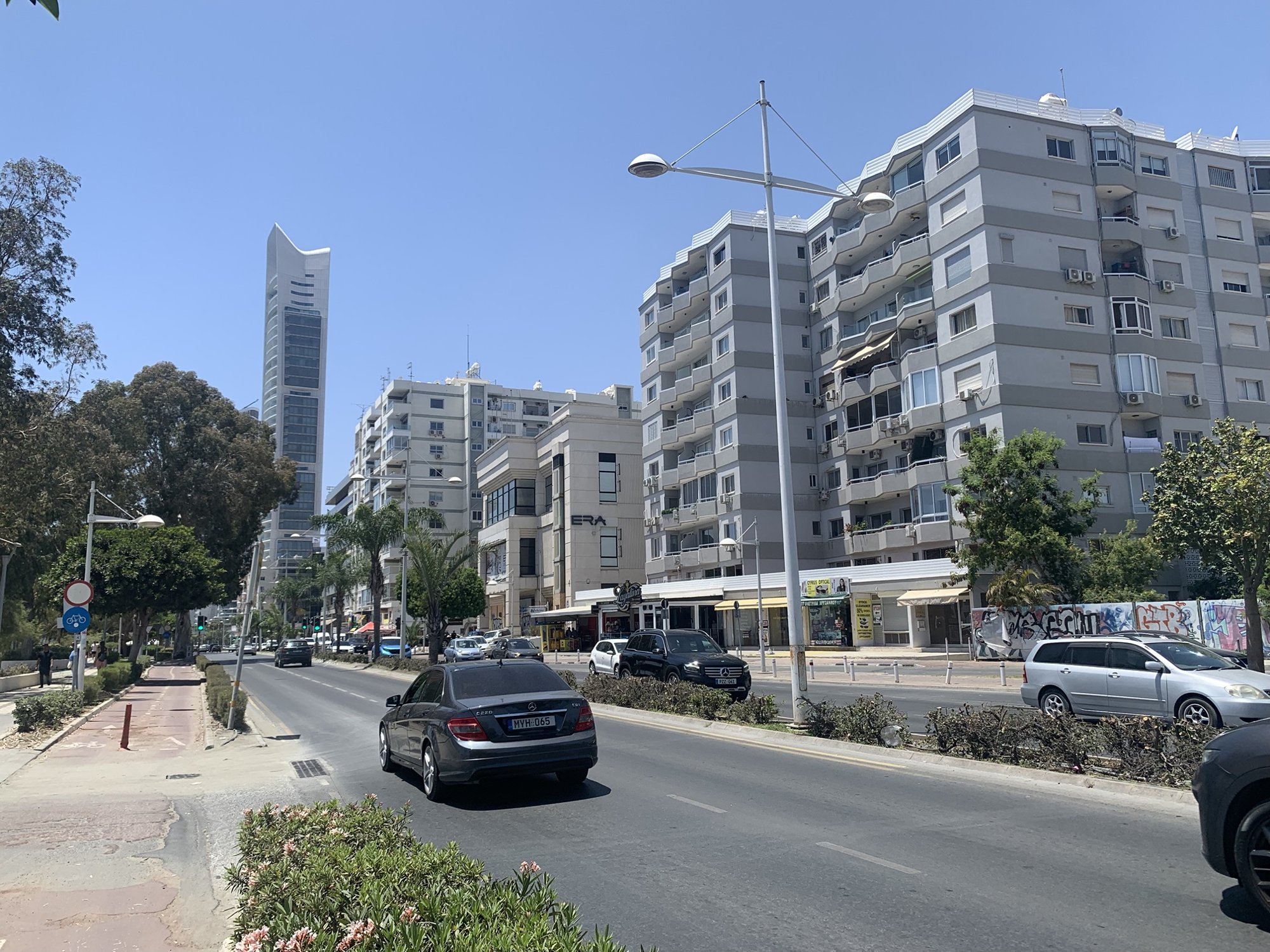
The seafront is the city's best walking and cycling route. The coastal path runs almost without a break for about 6 km from the Old Port to Dasoudi Beach in Germasogeia, including a stretch through the Dasoudi woods, and it is lit at night. Further east, another stretch of about 5.5 km links the hotel strip with the St Raphael resort area.
In the centre, Molos is a seaside park about 1 km long between the city centre and the old port. A cycle path along it connects the Olympion seafront with the Limassol Marina and the Garyllis linear park, which follows the river inland. Together they make the most practical car-free corridor in Limassol for commuting or school runs, and you rarely have to share them with traffic.
Away from the seafront you share most streets with traffic, so plan routes along quieter roads. In July 2026 the municipality presented plans for its first "mobility hub" near Nicos Pattichis Avenue. It would combine urban buses, shared bicycles, car-sharing and taxis, with parking for 150 bicycles. As of October 2026 it was still at the study stage, with construction expected to take about seven months once a contractor is appointed.
If you ride for sport, see our cycling routes finder for road and mountain-bike routes around Limassol district.
Is there bike sharing in Limassol?
Yes. nextbike Cyprus runs Limassol's public bike-sharing scheme. You find and unlock a bike in the nextbike app and return it to any official station. The Limassol Tourism Board lists 15 locations in the city, the service line 77788323 and the website nextbike.com.cy. Electric bikes were added in January 2025, and by February 2026 the fleet had 200 e-bikes. The EU CIVITAS metaCCAZE project funded 33 of them, and the e-bikes are rented four to five times as often as the conventional shared bikes. Check prices and monthly plans in the app.
Can you ride an e-scooter in Limassol?
Yes, but the rules tightened in 2026 and police enforce them actively. The main rules, as of 2026:
| Rule | What it means |
|---|---|
| Minimum age | 17 or over since 19 May 2026 (previously 14) |
| Helmet | Compulsory, fastened properly |
| At night | Reflective or hi-vis clothing from sunset to sunrise |
| Where you can ride | Roads with a 30 km/h limit and cycle paths or lanes; pavements and squares only where the local authority allows it |
| Where you cannot ride | Motorways, fast traffic roads and pedestrian areas, unless signs say otherwise |
| Speed | The speed above which penalties apply went up from 20 km/h to 25 km/h |
| The scooter | Must meet European safety standards and carry the certification markings |
Adults who let under-17s ride, and riders who carry an underage passenger, can be penalised. The police can also temporarily seize scooters used in breach of the rules. In a single weekend campaign in summer 2026, police brought 526 charges across Cyprus, including 219 for riding in prohibited areas and 116 for riding without a helmet.
The 2026 law also regulates companies that rent out scooters. Limassol has no dockless shared e-scooter scheme in 2026, so a scooter usually means buying one that meets the standards.
How do taxis and ride-hailing work in Limassol?
Bolt is the ride-hailing app that lists Limassol, and it also runs food delivery in the city. Uber does not operate in Cyprus. Licensed taxis come in three types:
- Urban taxis: metered, for trips within the city.
- Rural taxis: metered, and serve the villages.
- Shared (intercity) taxis: minibuses with fixed per-seat prices that carry several passengers between towns and pick up and drop off within town limits.
Ask the driver to start the meter, and ask for a receipt. Taxis are useful late at night, when buses become sparse.
How do you get to the airports and other towns?
- Limassol Airport Express runs non-stop air-conditioned coaches to Larnaca and Paphos airports. They leave from the Agios Georgios Havouzas station, which has free parking, and the Larnaca service also stops in the tourist area opposite the St Raphael hotel. The adult fare is about €10 (€5 for children), and you book online.
- The urban bus company's own airport service runs daily to both airports from in front of Saint George Havouzas church on Christofi Ergatoudi Street. The tourism board lists it at €9 per adult. Fares on the two services differ, so check the current price before you travel.
- Intercity Buses connect Limassol with Nicosia, Larnaca, Paphos and Paralimni–Ayia Napa, with regular departures from the Old Port. Drivers sell cash singles, and a personalised Motion card gives 50% off. Freephone: 8000 77 89.
What to do next
- Choose your area with transport in mind: compare the area guides above, or start from our Limassol hub.
- Download a journey planner and the nextbike app, and get a Motion card if you will ride the bus most days.
- Read our public transport in Cyprus guide for how the Motion card and island-wide buses work.
- If you will need a car later, see our guide to exchanging your driving licence.
Recommended for this guide
Contains affiliate links Airalo
 Discover Cars
Frequently asked questions
Can you live in Limassol without a car?
Yes, if you live near the seafront, in the Old Town, Neapolis or the Germasogeia tourist area. Buses, bikes, walking and Bolt cover most daily trips there. In hillside suburbs and villages such as Parekklisia or the upper part of Germasogeia, buses are infrequent and most residents drive.
How much is the bus in Limassol?
As of 2026, a daytime single on EMEL urban buses costs €2. You buy it from the driver. The Motion card gives discounted fares and passes, so check the current prices before buying a pass.
Which bus goes along the Limassol seafront?
Route 30 runs along the main coast road, from the Le Meridien hotel area near the Amathus ruins, past the New Port, to My Mall on the west side. Routes 30 and 31 both serve Amathus.
Are e-scooters legal in Limassol?
Yes, with conditions. Since 19 May 2026 riders must be 17 or over and wear a helmet, and they need hi-vis clothing at night. E-scooters are allowed on roads with a 30 km/h limit and on cycle paths, but not on motorways or in pedestrian areas unless signs allow it.
Is there Uber in Limassol?
Uber does not operate in Cyprus. Bolt is the ride-hailing app that lists Limassol, and you can also call or hail a licensed metered taxi.
How do you get from Limassol to the airport without a car?
Limassol Airport Express runs to Larnaca and Paphos airports from the Agios Georgios Havouzas station, with an extra stop opposite the St Raphael hotel on the Larnaca route. The adult fare is about €10, so book online and check the current price.
Useful links
- Limassol Tourism Board – Buses (EMEL and intercity)EMEL contacts, main routes and ticket information
- Limassol Tourism Board – Rent a bike (nextbike)How the nextbike scheme works and its service phone number
- Limassol Tourism Board – Airport transfersLimassol Airport Express and the urban buses' airport service
- Intercity Buses – Routes and timetablesLimassol to Nicosia, Larnaca, Paphos and Ayia Napa; freephone 8000 77 89
- Bolt – LimassolRide-hailing in Limassol
- Limassol Tourism Board – TaxiUrban, rural and shared (intercity) taxis
- Expatify – Public transport in Cyprus
- Expatify – Living in Limassol
Sources (20)
- Limassol Tourism Board – Buses
- Limassol Tourism Board – Airport transfers
- Limassol Tourism Board – Rent a bike
- Limassol Tourism Board – Useful information
- Limassol Tourism Board – Taxi
- Intercity Buses – Routes
- Bolt – Limassol
- Cyprus National Access Point – EMEL (Limassol) public transport data
- ROADPOL – New law to regulate personal mobility devices in Cyprus
- CIVITAS – Limassol marks one year of shared e-bike service success (2 February 2026)
- Cyprus Mail – Bus fare hike to go live in August (20 July 2026)
- Cyprus Mail – E-scooter age limit rise to 17 goes into force (19 May 2026)
- Cyprus Mail – Parliament raises scooter age limit to 17 as ban proposals rejected (16 April 2026)
- Cyprus Mail – Stricter scooter law failing to curb toll of serious accidents (25 August 2026)
- Cyprus Mail – Ministry welcomes amendment to electronic scooter regulation (16 July 2022)
- Cyprus Mail – Limassol to install new electric rental bikes (24 January 2025)
- Politis – Limassol: first mobility hub takes shape (29 July 2026)
- Cyprus Driving – New regulations on the use of e-scooters now in force (19 May 2026)
- All About Limassol – Molos park
- Great Runs – Limassol running overview