Quick answer
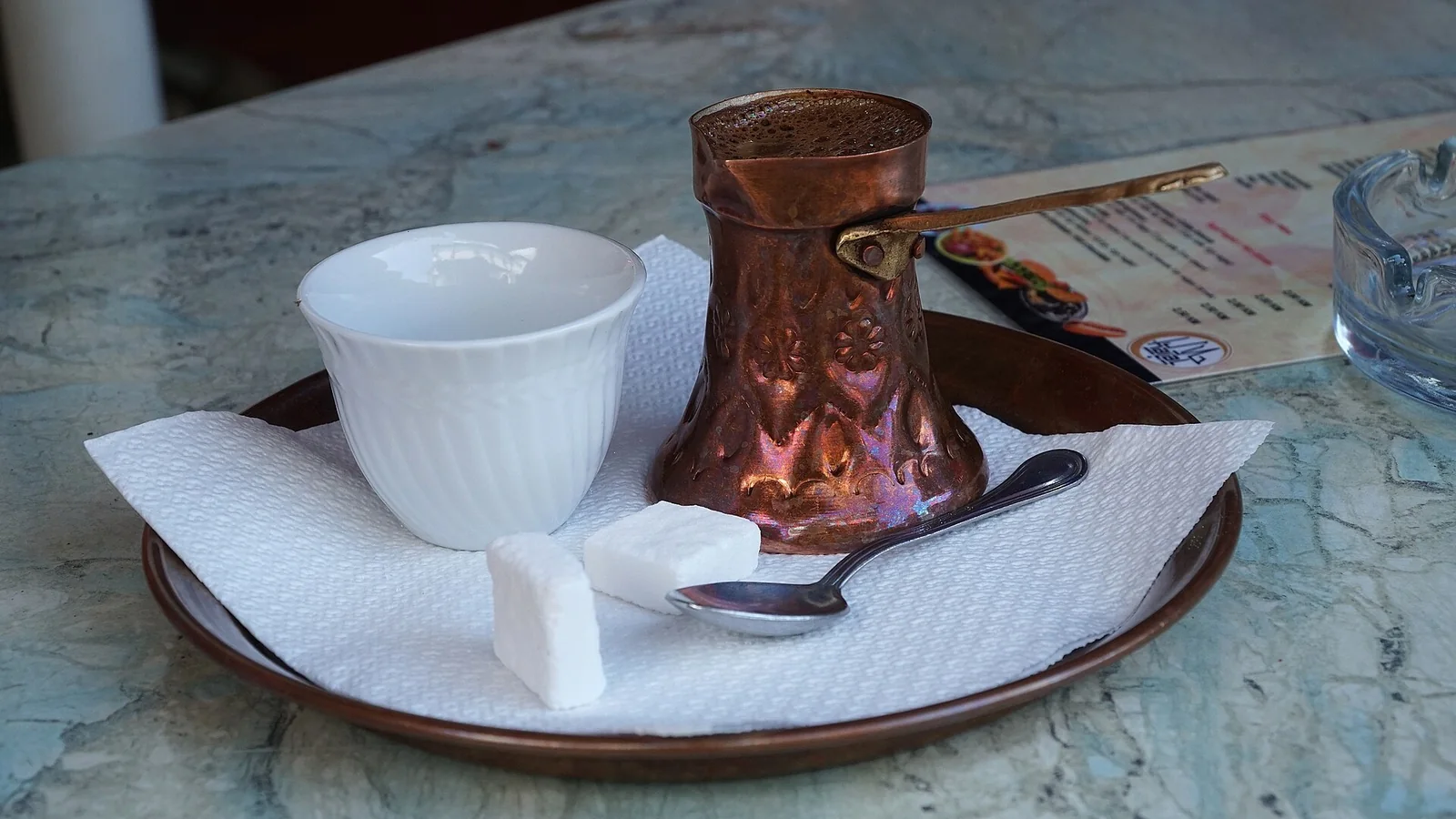
Cypriot coffee is finely ground coffee brewed slowly in a small long-handled pot called a briki, served in a small cup with a layer of foam (kaimaki) and a glass of cold water. You choose the sugar before it is made: sketos (no sugar), metrios (medium) or glykys (sweet), with in-between options too. For iced coffee, locals drink frappé (instant coffee shaken with ice) and the espresso-based freddo espresso and freddo cappuccino, which you order with the same sugar words.
- Cypriot coffee is brewed in a briki, with the sugar added at the start, so you must say how sweet you want it when you order.
- The three main levels are sketos (no sugar), metrios (medium) and glykys (sweet); Cypriots also ask for me oligi, mallon glykys or varys glykys.
- It is never served with milk, comes with a glass of cold water, and you leave the thick grounds at the bottom.
- The frappé is usually traced to the 1957 Thessaloniki International Fair, although some writers treat that story as a legend.
- Freddo espresso, espresso shaken with ice, appeared in Greece around 1991; freddo cappuccino adds a layer of cold milk foam.
Coffee in Cyprus is less a drink than a set of small rules: how sweet, hot or iced, and how long you plan to sit. Here is what surprises most newcomers, followed by a plain guide to each coffee and the exact words to use when you order.
What do most newcomers not know about coffee in Cyprus?
- You choose the sugar before it is made. With Cypriot coffee the sugar goes into the pot with the cold water, so "sugar on the side" does not work. Say how sweet you want it as you order.
- There are more than three sweetness levels. Besides the classic three, Cyprus Mail lists in-between options such as me oligi (a little sugar) and varys glykys (extra sweet).
- Milk never goes in. The Deputy Ministry of Tourism is clear: Cypriot coffee is never served with milk.
- Don't finish the cup. The thick grounds stay at the bottom, and the Deputy Ministry of Tourism notes that fortune-tellers traditionally read the dried patterns they leave to tell the future.
- The frappé is said to have been an accident. The best-known story puts its birth at a 1957 trade fair in Thessaloniki, when a Nescafé rep could not find hot water.
- The island's classic coffee mill was started by café owners. The Severis Foundation's CVAR museum says the Laikon coffee grinding company was founded in 1948 by a group of coffee-shop keepers who wanted a reliable supply of their main ingredient, starting with a second-hand roaster and six staff.
- "Let's go for coffee" means sitting down. Cyprus Mail notes that it usually means a long conversation, not a quick takeaway.
What is Cypriot coffee?
Cypriot coffee (kypriakos kafes) is the island's version of the unfiltered coffee found across the former Ottoman world. Coffee reached Cyprus through that world, and coffee shops are recorded on the island in the 17th century. The same drink is called Greek coffee in Greece.
According to Visit Nicosia and the Deputy Ministry of Tourism, it is made like this:
- Water is measured with the coffee cup itself and poured into a briki, a small pot with a long handle, traditionally made of copper.
- One heaped teaspoon of very finely ground coffee goes in per cup, with sugar if wanted.
- The pot is heated slowly, traditionally on a hovoli, a bed of hot sand, and taken off the heat just before it boils so that a layer of foam, the kaimaki, forms on top.
- It is poured into a small cup and served with a glass of cold water.
Sip it slowly and stop when you reach the sediment. Raise your cup with eis ygeian ("to good health").
How do you order coffee like a local?
Spellings vary between sources (sketo/sketos, glyki/glykys), but you will be understood either way. Sugar amounts for Cypriot coffee follow the Deputy Ministry of Tourism; the in-between levels come from Cyprus Mail.
| What to say | What you get |
|---|---|
| Ena kypriako sketo | A Cypriot coffee with no sugar |
| Me oligi | A little sugar, less than medium |
| Metrio | Medium: about one teaspoon of sugar |
| Mallon glyky | A bit sweeter than medium |
| Glyky | Sweet: about two teaspoons of sugar |
| Varys glyky | Extra sweet |
| Ena frappé metrio me gala | A medium-sweet frappé with milk |
| Freddo espresso sketo | An iced espresso, no sugar |
| Freddo cappuccino metrio | An iced espresso with cold milk foam, medium sweet |
For iced coffees the same words apply, but the spoonfuls are bigger: Tasting Table describes a metrios frappé as about two teaspoons of sugar and a glykos one as about four. Me gala simply means "with milk".
What is a kafeneio?
The kafeneio (plural kafeneia) is the traditional coffee shop, historically the centre of social life in villages and towns. Cyprus Mail describes it as a community hub where older residents meet daily to talk, play backgammon or cards and follow the news. Historically it was a men's space: a 2025 Cyprus Mail interview with an anthropologist describes it as belonging "exclusively to men", and notes that it once hosted business deals, marriage arrangements, post and tax collection, shadow-puppet shows and election speeches. That male-only kafeneio is fading, surviving longest in remote villages, while city coffee shops now draw a mixed crowd.
Where did the frappé come from?
A frappé is instant coffee shaken with cold water and ice until it is thick and frothy, then poured over ice, with milk if you like. Nescafé itself tells the origin story: at the 1957 Thessaloniki International Fair, its representative Dimitris Vakondios could not find hot water, so he shook instant coffee with cold water and ice. The Greek newspaper To Vima treats it as an urban legend rather than verified history. Either way, it became the summer coffee of Greece and Cyprus.
What are freddo espresso and freddo cappuccino?
The freddo is the frappé's espresso-based successor. A freddo espresso is a double espresso shaken hard with ice and poured over fresh ice; a freddo cappuccino adds a layer of thick, cold milk foam on top. To Vima says the freddo emerged around 1991, as espresso spread through Greece in the 1990s, and Tasting Table says it became popular in the 2000s. Many credit Yiannis Iosifides, founder of the Greek coffee company Kafea Terra, although its origin is disputed. Cyprus Mail notes that frappé, freddo espresso and freddo cappuccino are drunk almost all year in Cyprus.
How much does a coffee cost?
Prices vary by place. As a guide, on the café menus we checked on Wolt in October 2026, a Cypriot coffee cost €1.00 (€1.50 for a double) at a Paphos café, and a freddo espresso cost €2.20 to €2.65 at cafés in Limassol, Nicosia, Larnaca and Paphos. Beach bars charge more: Politis reported a freddo cappuccino at €5 on the Ayia Napa coast in July 2026.
What to do next
- Have your coffee brought to you: see our guide to coffee delivery in Cyprus.
- Pair it the Cypriot way with loukoumi or a spoon sweet from our guide to Cypriot desserts, or make loukoumades at home.
- Buy ground Cypriot coffee and a briki at the shops in our supermarkets guide, and explore more local flavours in our deep dive into food in Cyprus.
Recommended for this guide
Contains affiliate links GetYourGuide
Skip-the-line tickets, day trips and guided tours, usually with free cancellation up to 24 hours before.
See things to do in Cyprus
Hotels & places to stay
GetYourGuide
Skip-the-line tickets, day trips and guided tours, usually with free cancellation up to 24 hours before.
See things to do in Cyprus
Hotels & places to stay
 Booking.com
The widest choice of hotels, apartments and villas, with free cancellation on many rooms.
Find hotels in Cyprus
Flights & car hire
Booking.com
The widest choice of hotels, apartments and villas, with free cancellation on many rooms.
Find hotels in Cyprus
Flights & car hire
 Discover Cars
Compare car hire from local and international companies at Larnaca and Paphos airports.
Compare car hire
Discover Cars
Compare car hire from local and international companies at Larnaca and Paphos airports.
Compare car hire
Frequently asked questions
How do you order Cypriot coffee?
Ask for a kypriako (Cypriot coffee) and add the sugar level: sketo for no sugar, metrio for medium or glyky for sweet. The sugar goes in while it is brewed, so it cannot be added later.
What is the difference between frappé and freddo?
A frappé is made with instant coffee shaken with cold water and ice until frothy. A freddo espresso is made with fresh espresso shaken with ice, and a freddo cappuccino adds a layer of cold whipped milk on top.
Is Cypriot coffee the same as Greek or Turkish coffee?
It is prepared the same way, unfiltered in a small pot, and comes from the same Ottoman-era tradition. In Cyprus it is called Cypriot coffee and in Greece Greek coffee.
Why is Cypriot coffee served with water?
A glass of cold water always comes with it. Cyprus Mail notes that some people also pour a little water into the cup to cool and soften the coffee.
Can you add milk to Cypriot coffee?
No. The Deputy Ministry of Tourism says milk is never added to Cyprus coffee. If you want milk, order a frappé or freddo cappuccino instead.
What does metrios mean?
Metrios means medium. For Cypriot coffee it is about one teaspoon of sugar per cup, according to the Deputy Ministry of Tourism.
Useful links
- Visit Cyprus – Cyprus coffeeOfficial tourism page on how it is made and served
- Visit Nicosia – Café cultureNicosia's tourism board on coffee shops and the briki method
- Severis Foundation (CVAR) – the Laikon coffee grinding companyMuseum story of the café owners who founded a coffee mill in 1948
- Wolt – Magic Cafe, PaphosExample of a café that delivers Cypriot coffee
- Wolt – Bean Bar in LimassolCypriot coffee chain with seven Limassol branches on Wolt
- Foody Cyprus app (App Store)
- Bolt Food app (App Store)
Sources (10)
- Deputy Ministry of Tourism (Visit Cyprus) – Cyprus coffee
- Visit Nicosia – Café culture
- Cyprus Mail – Coffee culture in Cyprus explained: traditions, rituals and modern café trends (May 2026)
- Cyprus Mail – Cyprus society seen through coffee shop culture (July 2025)
- Severis Foundation (CVAR) – Did you know: the Laikon coffee grinding company tray
- NESCAFÉ – Did you know that NESCAFÉ invented the frappé?
- To Vima – Greece celebrates its long love affair with coffee (October 2026)
- To Vima – The freddo espresso: a modern Greek cultural phenomenon (May 2026)
- Tasting Table – Freddo vs frappé: the main difference between the Greek coffee styles
- Politis – A family beach day in Cyprus now costs around €120 (July 2026)