Quick answer
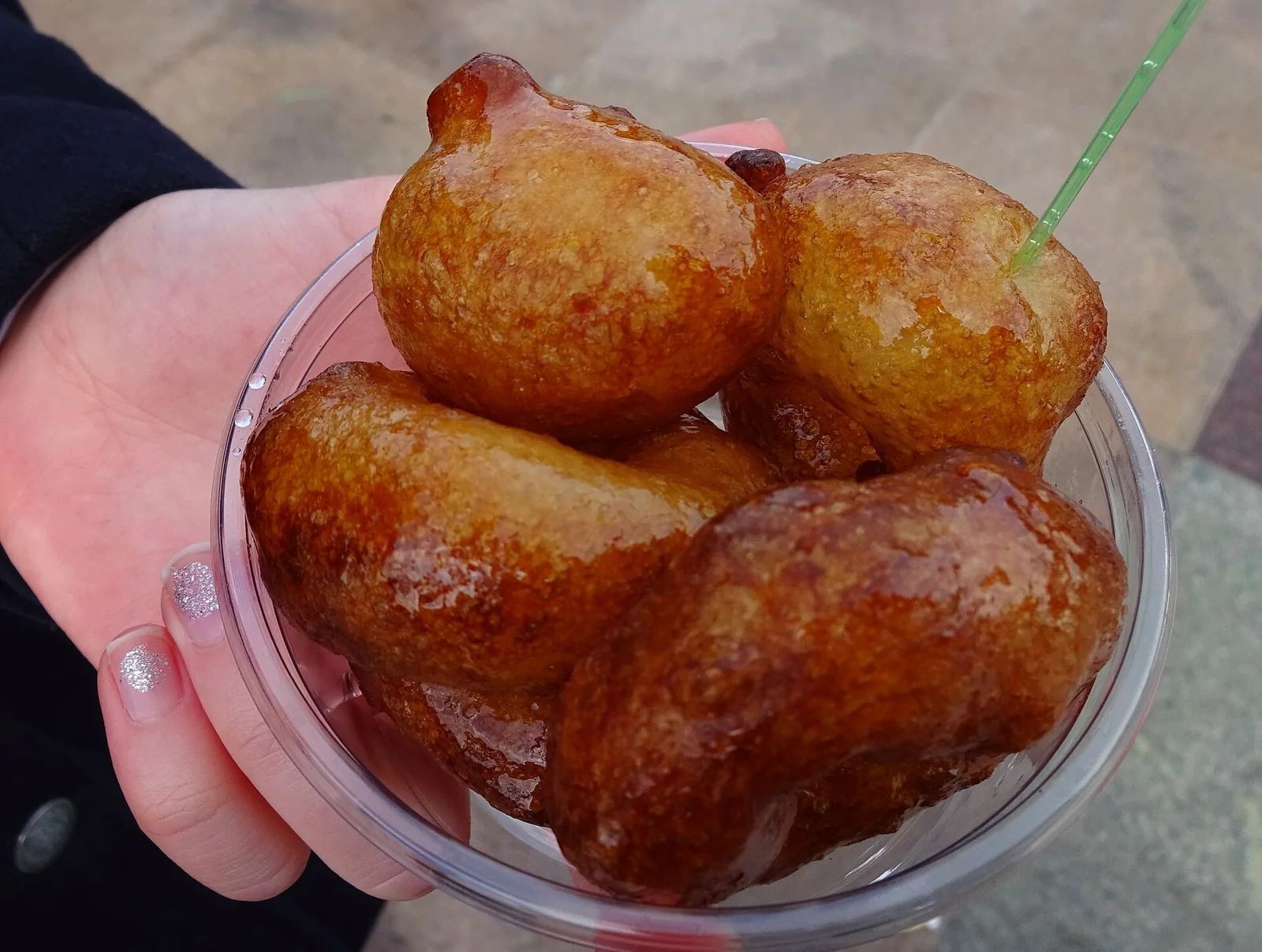
Loukoumades are small Cypriot doughnuts made from a loose yeast batter of flour, water, yeast and salt, deep-fried until golden and dropped into cool cinnamon and honey syrup. Allow about 1 hour for the batter to prove and around 45 minutes to make the syrup and fry the puffs.
- The batter needs about 1 hour to prove until bubbly and doubled.
- Fry at 175–180 °C so the puffs are crisp outside and airy inside.
- Hot puffs go into cool syrup, which keeps them crunchy.
- Made of flour, yeast and water, the basic batter is egg-free and dairy-free.
Recipe
Loukoumades
Ingredients
For the batter
For the syrup
For frying and to serve
Method
- Mix the flour, yeast, sugar and salt in a large bowl. Gradually beat in the lukewarm water with a wooden spoon or your hand until you have a smooth, thick, sticky batter that falls from the spoon in heavy ribbons, a little thicker than pancake batter. Add a splash more water if it is stiff.
- Beat the batter vigorously for 2–3 minutes to develop some stretch, then cover with a clean tea towel and leave in a warm spot for about 1 hour, until doubled and full of bubbles.
- Meanwhile, make the syrup. Put the sugar, water, cinnamon stick, cloves and lemon peel in a pan and bring to the boil, stirring until the sugar dissolves. Simmer for 5 minutes, take off the heat, stir in the honey and lemon juice, and leave to cool completely.
- Pour the oil into a deep, heavy pan so it is at least 6 cm deep but no more than one-third full. Heat over medium heat to 175–180 °C, checking with a cooking thermometer.
- Set a bowl of water and a teaspoon next to the batter. Grab a handful of batter and squeeze it up between your thumb and index finger to form a small ball, then scoop it off with the wet teaspoon and slide it gently into the oil. Alternatively, drop rounded teaspoons of batter straight into the oil, dipping the spoon in water each time.
- Fry in batches of 8–10, turning with a slotted spoon, for 3–4 minutes until deep golden and crisp all over. Keep the oil between 170 °C and 180 °C, adjusting the heat between batches.
- Lift the puffs out with a slotted spoon, let excess oil drip off for a few seconds, then drop them straight into the cool syrup. Turn to coat and leave for about 30 seconds.
- Transfer to a serving plate with a slotted spoon, dust with ground cinnamon and scatter with sesame seeds or drizzle with extra honey if you like. Serve immediately while still warm and crisp.
- When you have finished frying, turn off the heat and leave the oil to cool completely in the pan, away from the edge of the hob, before moving or straining it.
Tip: If the first puffs come out flat or greasy, the batter is too thin or the oil too cool; beat in a spoonful of flour or let the oil come back up to temperature before the next batch.
Loukoumades are bite-sized balls of yeast batter, fried until crisp and golden, then soaked in syrup scented with cinnamon and honey. Shatteringly crunchy outside and light as air inside, they are one of the great simple pleasures of Cypriot food.
They also happen to be cheap and easy to make at home once you know a few tricks, and a plate of them disappears faster than almost any other dessert.
What are loukoumades?
Loukoumades (λουκουμάδες), also called lokmades in Cypriot Greek, are small fried dough puffs. The batter is very simple: flour, yeast, water and a little salt, left to rise until bubbly. Spoonfuls are dropped into hot oil, where they puff up into irregular golden balls, and then they are coated in syrup or honey.
Cypriot loukoumades are usually on the small side, very crisp and served drenched in a cinnamon-flavoured syrup, sometimes with a dusting of icing sugar or ground cinnamon. They are best eaten within minutes of frying, often standing up, straight from a paper cone or plate.
Do not confuse them with loukoumi, the Cypriot version of Turkish delight. The names sound alike, but loukoumi is a soft, chewy sweet made from starch and sugar, while loukoumades are fried dough.
Where does the dish come from?
Fried dough in honey is very old indeed. Ancient Greek writers mention small honey-soaked fried cakes, and versions of the same idea are found across the eastern Mediterranean and the Middle East today. The Turkish lokma, the Arabic luqmat al-qadi and the Greek and Cypriot loukoumades are close relatives, and historians do not agree on a single point of origin. The name itself is generally thought to come from the Arabic word luqma, meaning a morsel or mouthful.
What is certain is that loukoumades have been part of Cypriot life for generations, closely tied to religious feasts and community celebrations.
Epiphany and the kalikantzari
In Cyprus loukoumades are especially linked with Epiphany (ta Fota) on 6 January, when many families fry a batch at home. According to folk tradition, mischievous goblins called kalikantzari roam the earth during the twelve days of Christmas and leave on Epiphany. In some villages people throw a few loukoumades or other sweets onto the roof as a parting offering to send them on their way. How widely the custom is still practised varies from place to place, but you will still hear older Cypriots talk about it.
Church fairs and festival stalls
Loukoumades are also a familiar sight at panigyria, the fairs held around a church or chapel on the feast day of its saint. Alongside stalls selling nuts, sweets and toys, there is very often someone frying loukoumades to order in a huge pan of oil. You will also often see loukoumades stalls at larger seasonal events, such as the Kataklysmos celebrations held in coastal towns around Pentecost, and at Christmas markets and village festivals.
Because the basic batter contains no eggs or dairy, loukoumades have also traditionally been acceptable during some Orthodox fasting periods, which helps explain their place in the religious calendar.
Which ingredients do you need and where can you buy them in Cyprus?
All the ingredients are easy to find. The recipe card gives quantities; here is what to look for.
- Flour: ordinary plain flour (alevri gia ola, all-purpose flour) works well. You do not need strong bread flour. Every supermarket, including Alphamega, Sklavenitis and Lidl, sells Cypriot and imported brands.
- Yeast: fast-action dried yeast in 7–8 g sachets is sold next to the flour. Fresh yeast is available in some supermarket chiller cabinets and bakeries if you prefer it; use roughly three times the weight of dried.
- Honey: Cyprus produces excellent honey, and thyme honey from the hills of Troodos and Paphos is particularly prized for its intense, herbal aroma. You can buy it in supermarkets, but it is also sold by beekeepers at laiki (open-air) markets, municipal markets and village shops, often at good prices. Because honey is the main flavour, it is worth buying a good one.
- Cinnamon: both sticks for the syrup and ground cinnamon for dusting are cheap and widely available.
- Sesame seeds: optional, but toasted sesame gives a pleasant nutty finish. Buy them from the baking aisle or loose from nut and spice shops.
- Oil: a neutral frying oil such as sunflower oil is the practical choice. Large bottles are sold in every supermarket.
How do you get it right?
Good loukoumades come down to three things: batter consistency, oil temperature and syrup temperature.
The batter
The batter should be thick and sticky, somewhere between pancake batter and soft bread dough. It should fall from a spoon slowly in heavy ribbons, not run off it. Flours absorb water differently, so add the last part of the water gradually. Beating it hard for a few minutes (step 2) builds a little gluten, which helps the puffs hold their shape and trap air. After proving, the surface should be domed and covered in bubbles.
Shaping
The traditional Cypriot method is to squeeze a handful of batter through your fist and scoop the ball that forms between thumb and forefinger with a wet spoon (step 5). It takes a few attempts to get the rhythm, and the first few puffs may look odd, which does not matter. Two wet teaspoons work perfectly well for beginners. Keep a bowl of water nearby and dip your spoon every time so the batter slides off cleanly.
Oil temperature
This matters more than anything else. At 175–180 °C the outside sets quickly and turns crisp while the inside steams and puffs up. If the oil is too cool, the loukoumades absorb oil and turn heavy and greasy. If it is too hot, they brown before the centre cooks and stay doughy inside. A cooking thermometer removes the guesswork. Without one, drop in a small blob of batter: it should sink briefly, then rise and start bubbling steadily within a few seconds.
Hot puffs, cool syrup
Dipping hot loukoumades into cool syrup (step 7) is the classic way to keep them crisp. Warm syrup on warm puffs makes them go soggy very quickly. Make the syrup first so it has time to cool completely.
Frying safely at home
Deep-frying is straightforward, but hot oil deserves respect.
- Never leave hot oil unattended, even for a moment. Turn off the heat if you need to step away.
- Use a deep, heavy pan and fill it no more than one-third full, so there is room for bubbling.
- Use a thermometer to keep the oil within range rather than letting it creep higher.
- If the oil starts to smoke, it is too hot. Turn off the heat straight away and let it cool down before carrying on. Do not add batter to smoking oil.
- Lower food in gently with a spoon, never drop it from a height, and shake excess water off the spoon first.
- Keep children and pets away from the cooker while you fry.
- In case of a fat fire, never use water. Turn off the heat if it is safe to do so and cover the pan with a fire blanket or a well-fitting lid, then leave it covered until completely cool. If the fire spreads, leave the room, close the door and call 112.
Let the oil cool fully in the pan before moving it. Strained oil can be reused once or twice for frying sweets; dispose of old oil at a recycling point rather than down the sink.
Variations
- Honey only: skip the syrup and drizzle warm loukoumades with warmed thyme honey, the style more common in Greece.
- Carob syrup: Cyprus is famous for its carob, and a drizzle of carob syrup (teratsomelo) makes a good honey alternative, especially for vegans.
- Nuts: scatter chopped toasted walnuts or pistachios over the top.
- Chocolate: modern stalls and cafés often serve loukoumades with chocolate sauce, praline or ice cream. Not traditional, but very popular.
- Orange blossom: a few drops of orange blossom water in the cooled syrup add a floral note.
What to serve with it
Loukoumades are usually eaten on their own as a snack or dessert. At home, they are lovely with a Cypriot coffee or a glass of cold water on a hot evening. For a more generous dessert, serve them with a scoop of vanilla ice cream or a spoonful of thick strained yoghurt to balance the sweetness. A bowl of fresh seasonal fruit on the table makes a good, lighter counterpoint.
How to store and reheat
Loukoumades are at their best within an hour of frying. If you have leftovers:
- Store them uncoated, if possible, in an airtight container at room temperature for up to a day. Syrup-soaked ones will be soft by the next morning.
- Re-crisp plain fried loukoumades in an oven preheated to 180 °C for 5–8 minutes, or in an air fryer for 3–4 minutes, then dip them in cool syrup.
- Freezing: you can freeze unsyruped loukoumades for up to a month. Re-crisp from frozen in the oven, allowing a few extra minutes.
- Syrup: leftover syrup keeps in a jar in the fridge for several weeks and is useful for drizzling over yoghurt or pancakes.
Where can you try it in Cyprus?
If you would like to taste loukoumades before trying them at home, look for:
- Church fairs (panigyria) in towns and villages on saints' days, where they are often fried fresh at outdoor stalls.
- Seasonal festivals, such as Kataklysmos events on the seafront, Christmas markets and village festivals in autumn.
- Bakeries and traditional sweet shops (zacharoplasteia), some of which fry loukoumades daily or at weekends, especially around Epiphany.
- Dedicated loukoumades cafés and kiosks in the larger towns, which tend to offer modern toppings alongside the classic syrup version.
- Meze restaurants, where a small plate of loukoumades sometimes arrives at the end of the meal.
For dates of upcoming festivals and fairs, see our Culture & festivals section, and browse all our recipes for more Cypriot dishes to make at home.
Recommended for this guide
Contains affiliate links GetYourGuide
Skip-the-line tickets, day trips and guided tours, usually with free cancellation up to 24 hours before.
See things to do in Cyprus
Hotels & places to stay
GetYourGuide
Skip-the-line tickets, day trips and guided tours, usually with free cancellation up to 24 hours before.
See things to do in Cyprus
Hotels & places to stay
 Booking.com
The widest choice of hotels, apartments and villas, with free cancellation on many rooms.
Find hotels in Cyprus
Flights & car hire
Booking.com
The widest choice of hotels, apartments and villas, with free cancellation on many rooms.
Find hotels in Cyprus
Flights & car hire
 Discover Cars
Compare car hire from local and international companies at Larnaca and Paphos airports.
Compare car hire
Discover Cars
Compare car hire from local and international companies at Larnaca and Paphos airports.
Compare car hire
Frequently asked questions
Should loukoumades be served with honey or syrup?
Both are traditional. In Cyprus loukoumades are usually dipped in a sugar syrup flavoured with cinnamon and often sweetened with honey, while in Greece they are frequently drizzled with honey alone. A syrup with some honey in it, as in our recipe, gives a crisp result with real honey flavour.
How do you keep loukoumades crisp?
Fry them at 175–180 °C so the crust sets quickly, dip them hot into syrup that has cooled completely, and leave them in it only briefly. Serve straight away: they soften within an hour or two as they absorb moisture.
Can I make the loukoumades batter ahead?
Yes. Make the batter with cold water, cover and refrigerate for up to 12 hours. It will prove slowly in the fridge. Take it out about 45 minutes before frying, beat it briefly and let it become bubbly again at room temperature.
What oil is best for frying loukoumades?
A neutral oil with a high smoke point, such as sunflower, corn or rapeseed oil, is the usual choice. Some cooks use light olive oil, but strongly flavoured extra virgin oil can overpower the delicate puffs and is costly in this quantity.
Are loukoumades vegan?
The basic Cypriot batter of flour, yeast, water and salt is vegan, and a plain sugar syrup keeps them so. Honey is not considered vegan by most people, so swap it for extra sugar or carob syrup if needed. Some modern recipes add milk or yoghurt, so check if buying them.