Summarise this page 7 key points · 1 minute
- Who built the Venetian walls of Nicosia, and why?When the Venetians decided to fortify Nicosia in 1567, the city was still surrounded by 14th-century Frankish walls.
- What route can you walk along the walls of Nicosia?The route runs west to east along the outer side of the walls and through the moat, ending at Famagusta Gate so you can go inside during its afternoon opening.
- How long is the walk, and when should you go?The whole circle is about 5 km, so the southern arc is roughly half that.
- What can you do near the buffer zone?Photography: GOV.UK advises against taking photos near military buildings and other sensitive areas, warning that you could be arrested.
- How do you get there: buses and parking?By bus: Solomou Square, next to Tripoli bastion, is the main bus hub in Nicosia and the city's main stop for intercity buses from Limassol, Larnaca and Paphos.
- Is the walk accessible, and is it safe?Eleftheria Square was designed with ramps between street level and the moat park, which makes it the most accessible section.
- Where can you stop for a coffee?The busiest café streets are just inside the walls: Ledra and Onasagorou streets, Faneromeni Square and the lanes of Laiki Geitonia, all a few minutes from Eleftheria Square.
Quick answer
You can walk the southern half of Nicosia's 16th-century Venetian walls in one easy morning, from Paphos Gate in the west past the Tripoli, D'Avila, Constanza, Podocataro and Caraffa bastions to Famagusta Gate in the east. The walls are free and open at all times; the rest of the circuit, including Kyrenia Gate, lies beyond the buffer zone and can only be reached through the Ledra Street or Ledra Palace pedestrian crossings with a passport or ID card.
- The Venetians began the walls in 1567 to a design by Giulio Savorgnano; they form a near-circle of about 5 km with eleven bastions and three gates.
- Five bastions and two gates (Paphos and Famagusta) are in the Republic-controlled south; Flatro bastion is in the buffer zone and Kyrenia Gate is in the north.
- The 80-metre-wide moat now holds gardens, sports grounds, an open-air sculpture exhibition and car parks, plus the Zaha Hadid-designed Eleftheria Square.
- Famagusta Gate reopened after restoration in January 2026; Visit Cyprus lists it as free, Monday to Friday, closed at weekends.
- Allow about 1–1.5 hours for the southern arc at an easy pace (our estimate from the map), longer with museum stops.
The easiest way to walk Nicosia's Venetian walls is to follow the southern half of the circle, from Paphos Gate in the west to Famagusta Gate in the east: about an hour to an hour and a half on foot, free, and open at any time. The northern half, with Kyrenia Gate, lies beyond the buffer zone and is reached only through the pedestrian crossings.
Below we give a short history, a stop-by-stop route past five bastions and two gates, what you can and cannot do near the buffer zone, and the practical side: buses, parking, timing and accessibility. If you are thinking of living inside the walls rather than just walking round them, see our Nicosia Old Town area guide.
Who built the Venetian walls of Nicosia, and why?
When the Venetians decided to fortify Nicosia in 1567, the city was still surrounded by 14th-century Frankish walls. These enclosed a much larger area, were too long for the Venetian garrison to defend, sat too close to the hills to the east and could not stand up to artillery, so the Venetians pulled them down and started again.
The new walls were designed by the military engineer Giulio Savorgnano (also spelt Savorgnan). They form a near-circle of about 5 km with eleven heart-shaped bastions. Savorgnano asked Nicosia's noble families to pay for the bastions, and each one took the name of the family that funded it. Thousands of displaced residents worked on them in shifts.
The work was never quite finished. When the Ottomans attacked in 1570, parts of the moat were still undug, and the city fell after a siege that same year. The walls were built mainly of mud brick with only the lower part faced in stone; the Ottomans later repaired them and covered the upper part in stone too, which is what you see today. The Pedieos river was diverted round the outside of the city, and the moat around the walls is about 80 metres wide.
The three gates
| Gate | Venetian name | Where it is today |
|---|---|---|
| Paphos Gate | Porta San Domenico | West, Republic-controlled south |
| Famagusta Gate | Porta Giuliana | East, Republic-controlled south |
| Kyrenia Gate | Porta del Proveditore | North of the buffer zone |
Which bastions can you visit?
Five bastions are in the Republic-controlled south: Tripoli, D'Avila, Constanza, Podocataro and Caraffa. Flatro, in the north-east corner, sits in the UN buffer zone. Roccas, next to Paphos Gate, lies beyond the ceasefire line and cannot be walked from the south, and Mula, Quirini, Barbaro and Loredano are in the north. So the walk below covers five bastions on foot and gives you views of two more.
What route can you walk along the walls of Nicosia?
The route runs west to east along the outer side of the walls and through the moat, ending at Famagusta Gate so you can go inside during its afternoon opening. You can also do it in reverse, or start in the middle at Eleftheria Square if you arrive by bus.
Map it · Walking route
Nicosia's Venetian walls from Paphos Gate to Famagusta Gate
- Paphos Gate
- Tripoli bastion
- Eleftheria Square and D'Avila bastion
- Constanza bastion
- Podocataro bastion
- Famagusta Gate
Opens Google Maps with every stop in order. Opening hours can change, so check before you go.
1. Paphos Gate
Start at the western entrance to the old city. Paphos Gate is a plain arched opening topped by a barrel vault, named after the old road to Paphos and also known as the San Domenico gate after a nearby abbey. The building above it is still a police station, as it was in British times. Just next to it you can see the gap the British cut through the walls in 1878 between the gate and Roccas bastion. In April 2024 the archaeological site at the gate was opened to visitors; excavations there uncovered the foundations of the Arab Ahmet aqueduct.
Look north from here and you are close to the buffer zone and Roccas bastion. Keep your camera pointed at the gate, not at the guard posts (see the buffer zone section below).
2. Tripoli bastion and Solomou Square
Head south-east along the walls to Tripoli bastion. Next to it is Solomou Square, Nicosia's main bus hub and the stop for intercity buses, so this is the natural starting point if you come by bus. The moat around here is mostly car parks.
3. D'Avila bastion and Eleftheria Square
D'Avila bastion holds the Nicosia Town Hall and the municipal library, looking down over Eleftheria Square. The square was redesigned by Zaha Hadid Architects, who won a European competition in 2005 against 46 other entries; it was inaugurated on 10 December 2021 with EU regional funding. The project covered about 20,000 m² and turned this stretch of the old moat into a sunken park with fountains, lawns, seating, a playground and an 80-seat amphitheatre, linked to the street by curved concrete ramps and a bridge.
The free guided walk "Discover the old Lefkosia (Nicosia) and its walls" starts at the Old Town Hall here (see below).
Detour inside the walls: from Eleftheria Square it is a few minutes into Laiki Geitonia, where the Leventis Municipal Museum at 15–17 Ippokratous Street is the city's history museum. Entry is free; Visit Cyprus lists it as open Tuesday to Sunday 10:00–16:30 and closed on Mondays and public holidays. The Deputy Ministry of Tourism information office is nearby at Aristokyprou 11 (+357 22 674264) if you want a free map.
For a view over the whole circle, the Shacolas Tower Museum and Observatory is on the 11th floor of the tower on Ledra Street. Nicosia Municipality lists it as open 10:00–17:00 from November to March; check the entry fee and whether it is operating normally before you go.
4. Constanza bastion
Continue east to Constanza bastion, with the small Bayraktar Mosque on top. Tradition says the first Ottoman flag was raised here when the city fell in 1570. The car park on this bastion is the usual home of the Ochi open-air farmers' market on Wednesdays and Saturdays, which was temporarily moved to the Podocataro car park in 2026; see our markets guide for details.
5. Podocataro bastion
The next bastion carries the Liberty Monument, erected in 1973. Along this side, as elsewhere around the walls, the moat holds gardens, sports grounds and car parks, and the bastion is a good spot to look back along the line of the walls you have just walked.
6. Caraffa bastion and Famagusta Gate
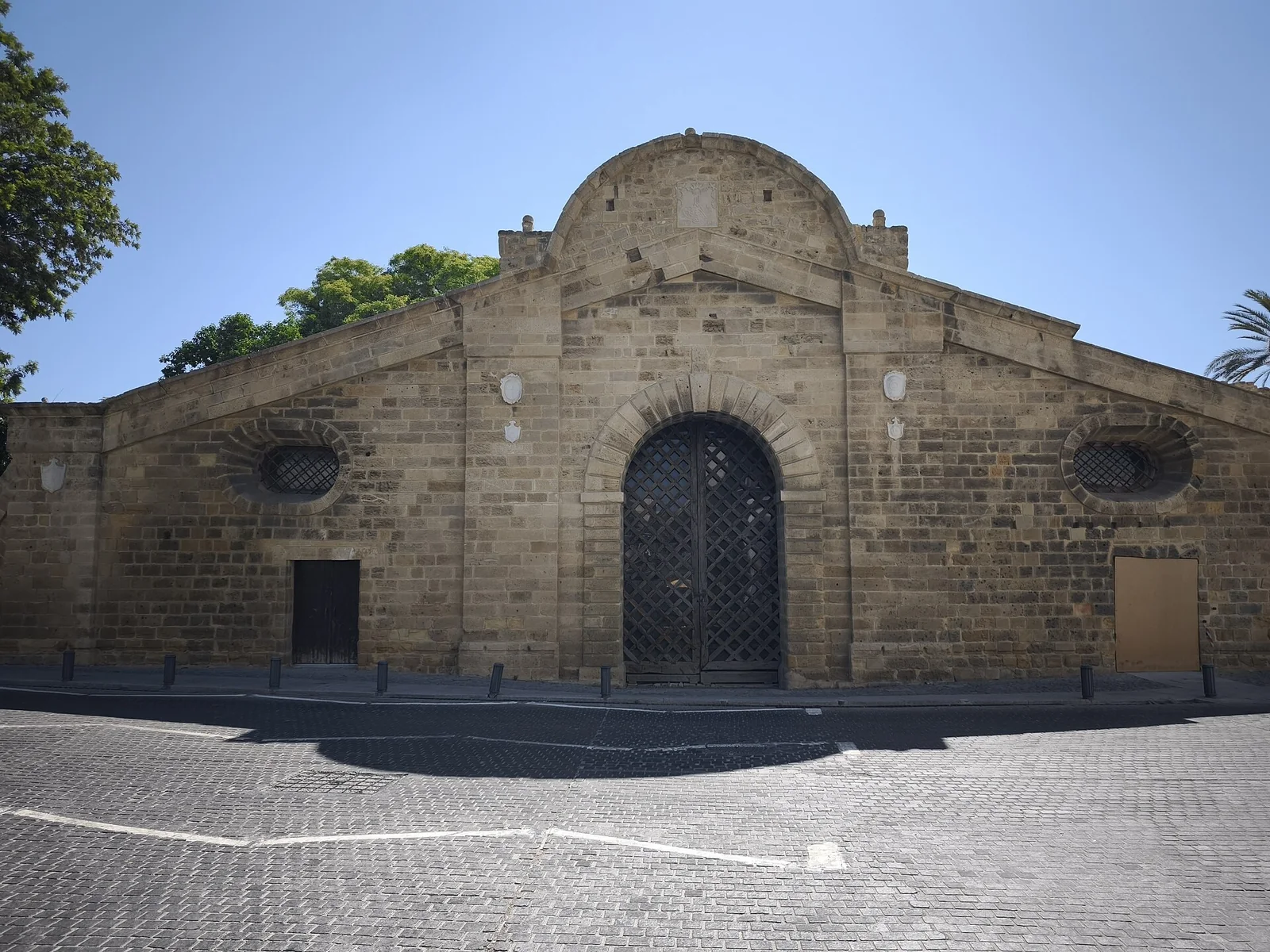
Finish at Famagusta Gate, originally called Porta Giuliana and the largest of the three gates. Its outer doorway is set into the angle of Caraffa bastion. Inside, a long vaulted passage leads to two side rooms, used by Nicosia Municipality as a cultural centre from 1981.
The gate flooded in 2018 and closed for years of restoration. The renovated monument was inaugurated on 9 January 2026 and has hosted events during Cyprus's EU Council Presidency. Entry is free. Visit Cyprus lists it as open Monday to Friday 10:00–13:00 and 16:00–19:00 from October to April (17:00–20:00 in the afternoon from May to September), closed at weekends and on public holidays. Phone +357 22 797 660 before you go, as exhibitions and events can affect access.
From here the walls continue north-east to Flatro bastion, which sits in the buffer zone and is not open to the public.
How long is the walk, and when should you go?
The whole circle is about 5 km, so the southern arc is roughly half that. It takes about an hour to an hour and a half at an easy pace. Allow a full morning if you add the Leventis Museum, Eleftheria Square and Famagusta Gate.
Best time: winter and spring mornings. Nicosia is inland and very hot in summer, and the moat paths have little shade at midday. On weekday mornings you can combine the walk with Famagusta Gate's morning session; on Mondays the Leventis Museum is closed. The Centre of Visual Arts and Research at 285 Ermou Street, inside the walls, opens Tuesday to Sunday 9:30–17:00 in its winter season (from 15 October to 15 May) and holds many historic watercolours of the walls.
Free guided walk: "Discover the old Lefkosia (Nicosia) and its walls" is a free walk in English of about 2 hours 45 minutes, starting and ending at the Old Town Hall on Eleftheria Square, run by Nicosia Municipality, the Deputy Ministry of Tourism and the Nicosia Tourism Board. As of October 2026 the winter 2026–27 programme had not been published; check Visit Nicosia or the information office.
What can you do near the buffer zone?
The walk takes you close to the Green Line, so a few practical points:
- Photography: GOV.UK advises against taking photos near military buildings and other sensitive areas, warning that you could be arrested. Do not photograph guard posts, soldiers or the barriers, and obey any no-photography signs.
- Do not enter closed areas. Streets that end in barrels, fences or signs are the edge of the buffer zone. Flatro bastion and the stretch near Roccas are off limits.
- Crossing to the north: the two crossings in central Nicosia are for pedestrians: Ledra Street, in the middle of the old town, and Ledra Palace, near the western end of the walls beyond Paphos Gate. You need a passport or ID card. Kyrenia Gate and the four northern bastions are on the other side. Read our guide to crossing to the north as a resident before you go, as the rules depend on your nationality and status.
How do you get there: buses and parking?
By bus: Solomou Square, next to Tripoli bastion, is the main bus hub in Nicosia and the city's main stop for intercity buses from Limassol, Larnaca and Paphos. Our public transport guide explains routes, tickets and apps.
By car: the Department of Antiquities notes that much of the moat is used for parking, and there are car parks at the foot of several bastions. They fill up quickly on weekday mornings, when the old town's offices and shops are busy. At weekends parking is easier. Use only the municipality's official payment methods at meters and car parks.
Is the walk accessible, and is it safe?
Eleftheria Square was designed with ramps between street level and the moat park, which makes it the most accessible section. Elsewhere, pavements around the walls are narrow in places, there are kerbs and busy roads to cross, and the moat paths and old stones are uneven, so pushchairs and wheelchairs will need some detours.
The southern walls are busy with traffic and pedestrians during the day and are generally a relaxed place to walk. As anywhere, keep valuables out of sight. Some streets near the buffer zone are deserted after dark, so walk this route in daylight.
Where can you stop for a coffee?
The busiest café streets are just inside the walls: Ledra and Onasagorou streets, Faneromeni Square and the lanes of Laiki Geitonia, all a few minutes from Eleftheria Square. Ermou Street has bars and cafés in restored buildings.
What to do next
Combine the walls with the museums and markets in our 10 best things to do in Nicosia, and if you are considering a flat inside the walls, read our Nicosia Old Town area guide. Planning to see Kyrenia Gate and the northern bastions? Start with our guide to crossing to the north as a resident.
Plan my trip
Want us to plan your days in Cyprus?
Tell us where you’re going, for how many days and what you love. We’ll send you a plan made for you, with places to see, where to eat and a Google Maps route for each day.
Recommended for this guide
Contains affiliate links GetYourGuide
Skip-the-line tickets, day trips and guided tours, usually with free cancellation up to 24 hours before.
See things to do in Nicosia, Cyprus
Flights & car hire
 Discover Cars
Compare car hire from local and international companies at Larnaca and Paphos airports.
Compare car hire
Flights & car hire
 GetRentacar
Rent a car directly from local rental companies, with the price and conditions shown before you book.
Find a rental car
Frequently asked questions
Can you walk all the way around the walls of Nicosia?
Not in one continuous loop from the south. The southern arc from Paphos Gate to Famagusta Gate is open to everyone, but the buffer zone cuts the circle at both ends. To see the northern bastions and Kyrenia Gate you must cross at Ledra Street or Ledra Palace with a passport or ID card.
How long does it take to walk the Venetian walls of Nicosia?
The whole circuit is about 5 km. The southern half, from Paphos Gate to Famagusta Gate, takes roughly an hour to an hour and a half at an easy pace, or a full morning with stops at Eleftheria Square, the Leventis Museum and Famagusta Gate.
Is Famagusta Gate in Nicosia open?
Yes. After a long closure caused by flooding in 2018, the restored gate was inaugurated on 9 January 2026. Visit Cyprus lists it as free, open Monday to Friday in two sessions and closed at weekends and on public holidays; call +357 22 797 660 before you go, as events can change access.
Is there a free guided walk of Nicosia's walls?
Yes. 'Discover the old Lefkosia (Nicosia) and its walls' is a free walk in English of about 2 hours 45 minutes, starting and ending at the Old Town Hall on Eleftheria Square. The 2026–27 winter dates had not been published as of October 2026; check Visit Nicosia or the tourist information office in Laiki Geitonia.
Where can I park to walk the Nicosia walls?
Many of the old town's car parks are in the moat itself, at the foot of the bastions, and some are run by Nicosia Municipality. Spaces fill up on weekday mornings, so a Saturday or Sunday start, or the bus to Solomou Square next to Tripoli bastion, is easier.
Useful links
- Visit Cyprus – The Medieval Walls of Lefkosia (Nicosia)
- Nicosia Municipality – The Medieval Walls
- Visit Cyprus – Famagusta Gate (Pyli Ammochostou)Opening hours and phone number
- Nicosia Municipality – Famagusta Gate
- Visit Cyprus – Discover the old Lefkosia (Nicosia) and its walls (free guided walk)
- Visit Cyprus – Leventis Municipal Museum of NicosiaFree, closed on Mondays
- Nicosia Municipality – Shacolas Tower Museum and Observatory
- Centre of Visual Arts and Research (CVAR)
Sources (13)
- Deputy Ministry of Tourism (Visit Cyprus) – The Medieval Walls of Lefkosia (Nicosia)
- Nicosia Municipality – The Medieval Walls
- Deputy Ministry of Tourism (Visit Cyprus) – Famagusta Gate (Pyli Ammochostou)
- Deputy Ministry of Tourism (Visit Cyprus) – Pafos (Paphos) Gate
- Department of Antiquities – Fortifications of Nicosia, World Heritage nomination form (2007, PDF)
- European Commission – Nicosia inaugurates Eleftheria Square after EU-funded facelift (10 December 2021)
- GOV.UK – Cyprus travel advice: safety and security
- Politis – Famagusta Gate to the Cyprus Presidency (9 January 2026)
- Cyprus News Agency – Famagusta Gate to be used during Cyprus EU Presidency (9 January 2026)
- Cyprus Mail – Famagusta Gate to be ready for EU presidency (9 July 2025)
- Cyprus Mail – Nicosia's historic Paphos Gate opened to visitors (22 April 2024)
- CVAR – Did you know? The walls of Nicosia
- Wikipedia – Walls of Nicosia