Summarise this page 10 key points · 1 minute
- Getting to Naples from CyprusFrom Paphos: Ryanair has flown Paphos–Naples as a seasonal route.
- From the airport into the city: the AlibusNaples airport (Capodichino) is close to the city.
- The historic centreThe historic centre of Naples has been a UNESCO World Heritage Site since 1995, and the protected area covers around 1,000 hectares.
- Pizza and foodIn 2017 UNESCO added the art of the Neapolitan pizzaiuolo, the hand-made dough and the wood-fired oven, to its list of the world's intangible cultural heritage.
- Funiculars, steps and views over the cityNaples is built up a steep hill, and the best views are from the Vomero district at the top.
- Mount Vesuvius: walking the crater pathThe walk to the crater is the national park's trail 5, Il Gran Cono.
- Pompeii and HerculaneumBoth towns were buried by the eruption of Vesuvius in AD 79.
- When to goSpring and autumn are the most comfortable times for walking the old town and climbing Vesuvius.
- Where to stayCentro Storico: right among the sights and pizzerias, and lively until late.
- A simple three-day planDay one: arrive, take the Alibus in, walk Spaccanapoli and San Gregorio Armeno, and have pizza for dinner.
Quick answer
Naples makes a full long weekend from Cyprus: a UNESCO-listed historic centre, the pizza that made the city famous, funiculars and old stepped lanes up to the viewpoints of Vomero, and Vesuvius, Pompeii and Herculaneum all within reach by local train. Ryanair has flown Paphos–Naples as a seasonal route (on Wednesdays and Saturdays in summer 2026), and there is no direct flight from Larnaca, so out of season connect via Athens or fly to Rome. Tickets for the Vesuvius crater path are sold online only, for a set time slot, and the crater closes in bad weather.
- Ryanair's Paphos–Naples route is seasonal (Wednesdays and Saturdays in summer 2026, about 2h 55m); there is no direct flight from Larnaca, so connect via Athens or fly to Rome.
- The Alibus links Capodichino airport with Piazza Garibaldi (Napoli Centrale station) and the port, for about €5 a ticket (2026).
- Vesuvius crater tickets are sold online only, for a time slot: full price from about €10, €8 for under-25s with ID, free for under-6s. From November to February the last entry is at 15:00.
- Pompeii tickets cost €20 (Pompeii Express) or €25 (Pompeii Plus) as of 2026, they carry your name, and entry is free on the first Sunday of the month.
- Naples is one hour behind Cyprus all year.
Naples is loud, steep, generous and unlike anywhere else in Italy. In one long weekend you can eat pizza where it was born, walk streets laid out by Greek settlers, look down on the bay from a 700-year-old stairway and stand on the rim of Vesuvius. Pompeii and Herculaneum are a short train ride away. Here is how to do it from Larnaca or Paphos.
Prices and opening hours change, so check the official pages in our links before you go.
Getting to Naples from Cyprus
From Paphos: Ryanair has flown Paphos–Naples as a seasonal route. In summer 2026 it ran on Wednesdays and Saturdays, with a flight time of about 2 hours 55 minutes. Check Ryanair's site for the dates the route runs before you plan a trip around it.
From Larnaca: there is no direct flight to Naples. Look for connections via Athens, which has year-round flights from both Cypriot airports, or fly direct to Rome (Wizz Air from Larnaca, Ryanair from Paphos) and take the train south.
Time difference: Naples is one hour behind Cyprus all year.
If you are planning a family break around the school holidays, our guide to half-term trips with kids on direct flights from Cyprus compares the other routes from Larnaca and Paphos.
From the airport into the city: the Alibus
Naples airport (Capodichino) is close to the city. The easiest way in is the Alibus, run by ANM, the city's transport company. It stops at Piazza Garibaldi, outside Napoli Centrale station, then carries on to the port near Molo Beverello and Piazza Municipio.
- Fare: about €5 a single (2026). Buy it from the machines in the arrivals hall, at a tobacconist, or in the ANM or Giranapoli apps, and validate it on board.
- Journey time: about 20–30 minutes to Piazza Garibaldi and 35–40 minutes to the port, depending on traffic.
- Frequency: buses run from early morning until around midnight, every 15–30 minutes.
Piazza Garibaldi is also where you catch the Circumvesuviana trains for Herculaneum, Pompeii and Vesuvius, so it is a useful place to know.
The historic centre
The historic centre of Naples has been a UNESCO World Heritage Site since 1995, and the protected area covers around 1,000 hectares. Its street plan goes back to the Greek city: three long parallel streets, the decumani, run east to west, crossed by narrow lanes. The lowest of them is known as Spaccanapoli, "the street that splits Naples", because from the hill of San Martino it looks like a straight cut through the old town.
A good first morning:
- Spaccanapoli and Via dei Tribunali: walk both, slowly. They are lined with churches, courtyards, bakeries and tiny shops.
- Via San Gregorio Armeno: the street of the nativity-scene workshops, full of handmade shepherds and figurines. In December it is at its busiest and most festive.
- Cappella Sansevero: a small chapel-museum on Via Francesco De Sanctis, home to the marble Veiled Christ. Tickets cost about €12 (2026), are in your name and must be booked online. It opens 09:00–19:00 and is closed on Tuesdays.
Map it · Walking route
A morning in the historic centre
- Cappella Sansevero
- Via San Gregorio Armeno
- L'Antica Pizzeria da Michele
Opens Google Maps with every stop in order. Opening hours can change, so check before you go.
Pizza and food
In 2017 UNESCO added the art of the Neapolitan pizzaiuolo, the hand-made dough and the wood-fired oven, to its list of the world's intangible cultural heritage. In Naples, pizza is everyday food rather than a treat.
- L'Antica Pizzeria da Michele (Via Cesare Sersale 1/7) has been baking since 1870 and serves only two pizzas: the margherita and the marinara (tomato, garlic and oregano). Take a numbered ticket at the door and wait to be called.
- Via dei Tribunali has pizzerias almost door to door. Try a pizza fritta, the fried, folded version, from a street counter.
- Sweet things: a sfogliatella (crisp, layered pastry filled with ricotta and semolina) or a rum babà with your morning espresso.
Neapolitan coffee is short and strong, and most people drink it standing at the bar.
Funiculars, steps and views over the city

Naples is built up a steep hill, and the best views are from the Vomero district at the top. Three funiculars climb from the centre to Vomero:
- Centrale: from Augusteo, just off Via Toledo, to Piazza Fuga.
- Chiaia: from Parco Margherita to Via Cimarosa.
- Montesanto: from Montesanto to Via Morghen.
The lines close from time to time for maintenance, so check ANM's service notices on the day.
Once at the top, walk to Largo San Martino, beside the Certosa di San Martino and Castel Sant'Elmo, for the classic view over the bay and Vesuvius.
Then come down on foot. The Pedamentina di San Martino is a stairway of 414 steps, first built in the 14th century, which zigzags from Largo San Martino down to Corso Vittorio Emanuele. On the way you look out over the bay, the Certosa's gardens and Vesuvius. Going down is much easier than going up, so take the Montesanto funicular to Morghen (about seven minutes' walk from Largo San Martino) and walk back down.
Naples has many other old stepped lanes, and they are at their best at dusk, when the lights come on across the city and the bay. Wear shoes with grip, as the stone can be slippery.
Mount Vesuvius: walking the crater path
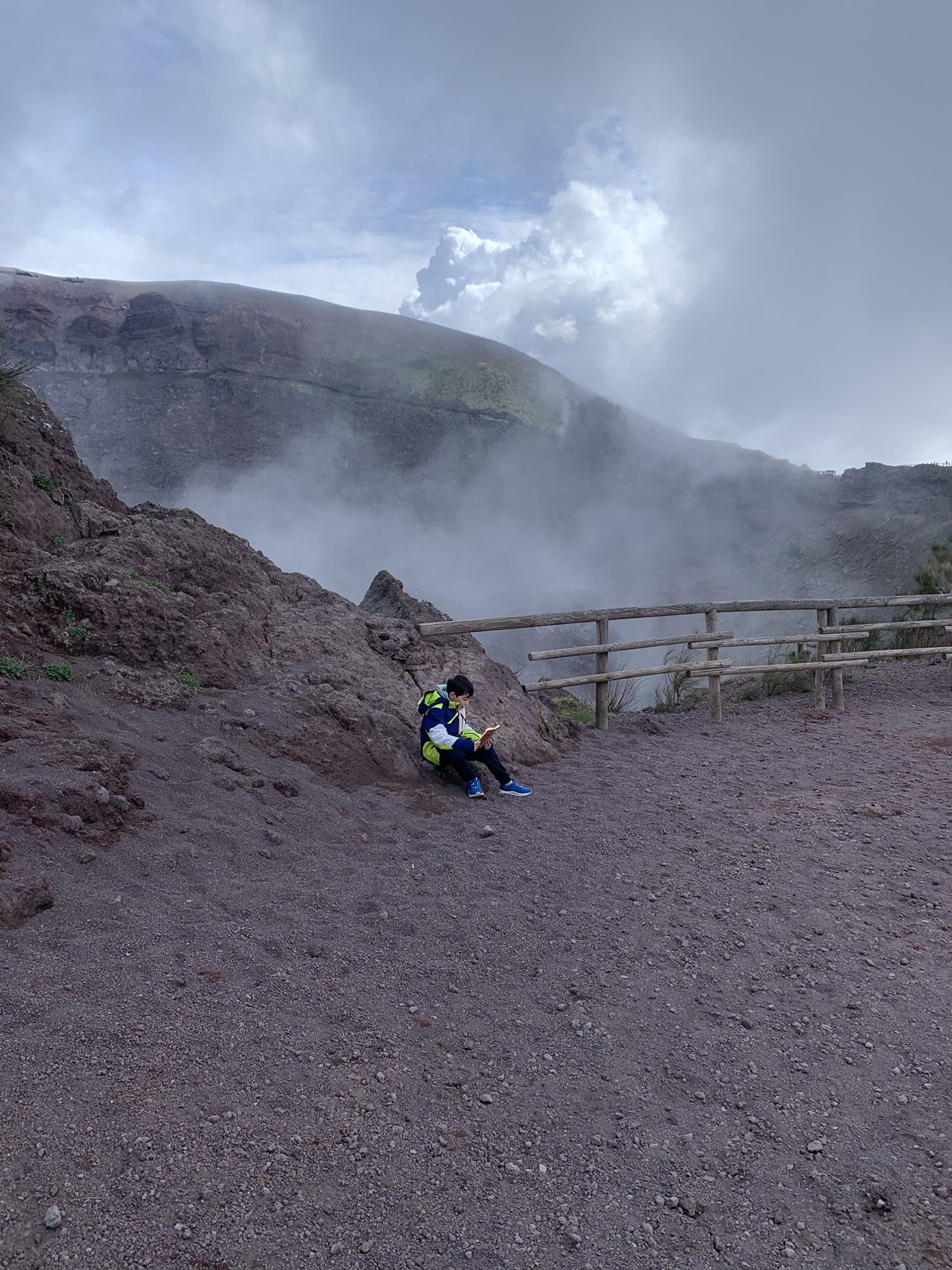
The walk to the crater is the national park's trail 5, Il Gran Cono. It starts at Piazzale Quota 1000 above Ercolano and climbs a wide gravel path to the rim, at about 1,170 metres. The park rates it easy, but the volcanic gravel underfoot is loose. Allow about two to two and a half hours there and back.
Tickets: online only, in advance. There is no ticket office at the entrance. Buy your ticket on the park's official ticketing site, for a set date and time slot, and pay by card. Tickets are in each visitor's name, so carry ID.
- Price: the park lists full-price tickets from €10, and they were selling at about €11.70 in summer 2026. Under-25s and residents of the park's 13 towns pay €8 with ID. Children under 6 go free with a parent or guardian.
- Hours: the path opens at 09:00. The last entry is at 15:00 from November to February, 16:00 in March and October, 17:00 from April to June and in September, and 18:00 in July and August. You must finish within an hour of the last entry.
- Weather: the park closes the crater automatically on days with an orange (or higher) weather alert from the regional Civil Protection, and also for strong wind, snow or fire risk. Unused tickets are refunded when the park closes.
- The route: the full loop around the rim has been closed for safety works, and the path currently ends at a point called the Capannuccia. Walking the northern and eastern sides of the summit is not allowed.
- What to bring: closed shoes, water and an extra layer for the wind at the top. There are no toilets at Quota 1000.
Getting there without a car. Take the Circumvesuviana from Napoli Garibaldi:
- From Ercolano Scavi station: shuttle buses, including the Vesuvio Express, and taxis go up to Quota 1000.
- From Pompei: the EAV public bus leaves from Piazza Anfiteatro and stops near Pompei Scavi–Villa dei Misteri station on its way up. The ride takes about 55 minutes.
By car: you cannot park at Quota 1000. Use the Ercolano municipal car parks along the road up. From the car park at 800 metres a council shuttle runs to the top for €1 each way, or you can walk about 1.8 km (around 30 minutes).
Pompeii and Herculaneum
Both towns were buried by the eruption of Vesuvius in AD 79. Together with the villas of Torre Annunziata (Oplontis), they have been a UNESCO World Heritage Site since 1997. Both are on the Circumvesuviana line from Napoli Garibaldi.
Pompeii is huge, so plan at least half a day.
- Tickets (as of 2026): €20 for Pompeii Express (the ancient city) or €25 for Pompeii Plus, which adds the Villa of the Mysteries and other suburban villas. EU citizens aged 18 to 24 pay €2. Entry is free on the first Sunday of every month, so expect crowds then.
- Named tickets: every ticket carries the holder's name, and there is a cap of 20,000 visitors a day. Buy online and carry ID.
- Winter hours (15 October–15 March): 09:00–17:00, with the last entry at 15:30. Closed on 25 December and 1 January.
- Entrances: Porta Marina, Piazza Anfiteatro and Piazza Esedra.
Herculaneum (Ercolano) is much smaller and quieter than Pompeii, and two or three hours is enough. It is about 10 minutes on foot downhill from Ercolano Scavi station, at Corso Resina 187. From 15 October to 15 March it opens 08:30–17:00, with the last entry at 15:30.
Herculaneum and the Vesuvius crater share the same station, so they pair well in one day: the crater in the morning, Herculaneum after lunch.
When to go
Spring and autumn are the most comfortable times for walking the old town and climbing Vesuvius. Summer is hot and crowded at Pompeii, though the crater stays open later. December is a lovely time for the city itself: San Gregorio Armeno is in full nativity-scene season and the streets are lit up for Christmas. Just remember the short winter hours at the archaeological sites and on the crater, and keep a flexible day in case bad weather closes Vesuvius.
Where to stay
- Centro Storico: right among the sights and pizzerias, and lively until late. Ask about noise before you book.
- Toledo and the Quartieri Spagnoli: central, close to the Centrale funicular and the metro, with plenty of small hotels and apartments.
- Chiaia: the smarter seafront district, with good restaurants and the Chiaia funicular up to Vomero.
- Vomero: quieter and residential, with the best views, and a funicular ride from the centre.
- Around Piazza Garibaldi: handy for the Alibus and the Circumvesuviana if you are out early to Pompeii or Vesuvius, but less pleasant at night than the districts above.
A simple three-day plan
- Day one: arrive, take the Alibus in, walk Spaccanapoli and San Gregorio Armeno, and have pizza for dinner.
- Day two: the Vesuvius crater in the morning, Herculaneum or Pompeii in the afternoon.
- Day three: a funicular up to Vomero, the view from Largo San Martino, the Pedamentina steps down, then the Alibus back to the airport.
For more short breaks from Larnaca and Paphos, see our guide to half-term trips with direct flights from Cyprus.
Plan my trip
Want us to plan your days in Cyprus?
Tell us where you’re going, for how many days and what you love. We’ll send you a plan made for you, with places to see, where to eat and a Google Maps route for each day.
Recommended for this guide
Contains affiliate links GetYourGuide
Frequently asked questions
Are there direct flights from Cyprus to Naples?
Ryanair has flown from Paphos to Naples as a seasonal route, on Wednesdays and Saturdays in summer 2026. There is no direct flight from Larnaca. Out of season, check Ryanair for the route's return dates, or connect via Athens, or fly direct to Rome and take the train south.
Do I need to book the Vesuvius crater in advance?
Yes. Tickets for the Gran Cono path (trail 5) are sold online only, through the national park's official ticketing site, for a set time slot. There is no ticket office at the entrance, so book before you set off.
How much does it cost to walk up to the crater of Vesuvius?
The national park lists full-price tickets from €10, with tickets selling at about €11.70 in summer 2026. Under-25s and residents of the park's 13 towns pay €8 with ID, and children under 6 go free with a parent.
Can I do Pompeii and Vesuvius in one day?
Yes, if you start early. Visit the crater in the morning, then take the EAV bus down to Pompei, or the other way round. In winter, keep the last entries in mind: 15:00 for the crater and 15:30 for Pompeii.
Is Herculaneum worth it if I have already seen Pompeii?
Yes. Herculaneum is much smaller and quieter than Pompeii, and you can see it in two or three hours. It is a 10-minute walk downhill from Ercolano Scavi station, the same station you use for the Vesuvius shuttles, so the two pair well in one day.
Useful links
- Vesuvius National Park – Gran Cono (crater path) tickets and rulesOnline-only tickets, hours, weather closures
- Pompeii Archaeological Park – timetables and tickets
- Herculaneum Archaeological Park – visitor information
- Visit Naples – the historic centre, a UNESCO site since 1995
- Ryanair – flights from Paphos to NaplesCheck the seasonal dates
Sources (21)
- Wikipedia – Paphos International Airport: airlines and destinations
- Wikipedia – Larnaca International Airport: airlines and destinations
- Planemapper – Ryanair FR639 Paphos–Naples flight history (autumn 2026)
- Zbordirect – Paphos to Naples low-cost flights
- Napolike – From Naples airport to the city centre: Alibus, taxis and shuttles (August 2026)
- Napolike – Alibus for Capodichino airport
- Visit Naples – The historic centre of Naples, a UNESCO World Heritage Site since 1995
- UNESCO – Art of Neapolitan 'Pizzaiuolo'
- Michelin Guide – Da Michele, Naples
- Napolike – Cappella Sansevero and the Veiled Christ: visitor guide (August 2026)
- Fanpage – The funiculars of Naples: stations and routes
- Napolike – The Pedamentina of Naples: history and how to get there
- Vesuvius National Park – Trail 5, Il Gran Cono
- Vesuvius National Park – Il Gran Cono (2026 page)
- Napolike – The Gran Cono path: how to reach the crater of Vesuvius (August 2026)
- Visit Pompeii Vesuvius – EAV bus schedule Pompei–Vesuvius 2026
- Pompeii Archaeological Park – Timetables and tickets
- Pompeii Archaeological Park – Nominative tickets and a daily limit of 20,000 admissions
- UNESCO – Archaeological Areas of Pompei, Herculaneum and Torre Annunziata (via Pompeii Archaeological Park)
- CoopCulture – Archaeological Park of Herculaneum: opening hours
- Napolike – Herculaneum free on 1 and 4 November 2026